When A Bird is Not Well...
 All bird owners who have their birds best interests at heart are seeking ways to optimize their health.
Stress, pollution, prescription drugs, the overuse of antibiotics and a poor diet all contribute to the ill health
of our birds. These adverse factors also apply to our health.
All bird owners who have their birds best interests at heart are seeking ways to optimize their health.
Stress, pollution, prescription drugs, the overuse of antibiotics and a poor diet all contribute to the ill health
of our birds. These adverse factors also apply to our health.
When a bird is not well, the healer and owner work together to find the underlying
cause and 'cure' it, rather than just eliminating symptoms. Addressing symptoms
alone often makes the cause of disease manifest itself in other ways.
One day of illness for a bird is like seven days of illness for a human.
So when you first recognize that your bird is ill, it's important to seek help quickly.
Buying a general purpose antibiotic at your local pet shop in order to medicate your bird,
first allows your bird to become even more ill.
Holistic comes from the word 'whole'. When we look at a pet bird holistically,
we consider the bird's whole being, which includes mental, emotional, and spiritual
aspects. Each of these factors affects health and is taken into consideration
when evaluating our bird holistically. Some of these factors include:
- Diet and nutrition
- Housing and surrounding environment
- Social interaction and companionship
- Physical stimulation, exercise and play
Why Does My Bird Pick Its Feathers?
Medical Causes of a
Feather Plucking, Picking and Mutilation in Pet Birds
Julie Burge, DVM
Some causes, not related to any disease,may include:
-
 Boredom in the very intelligent larger parrot species
- Insecurity, Stress, or Nervousness (can be caused by a change in daily
routine, a new environment, remodeling, other pets, or a new owner)
- Overcrowded housing: Finches in particular
- Sexual frustration in a mature bird
- Overenthusiastic plucking of a brood patch by an egg laying female
- Excessive courtship behavior: one bird plucks the other
- Parents picking their chicks to drive them from the nest so they can breed again
- Inadequate bathing facilities and low humidity
- Breed predisposition, as in Quaker Mutilation Syndrome
Optimum Avian Nutrition
Commercial Pelleted Diet versus a Fresh, Wholesome Diet
Excerpts below from Avian Nutrition by Alicia McWatters, Ph.D., C.N.C.
For a little over a decade, many bird owners have relied upon what is called
a complete, nutritionally-balanced, and manufactured
pelleted diet. Feeding a synthetic commercial feed has been touted as the
best or better way to feed your bird and as a result
has convinced the public at large that it is true. Sadly, our birds are the victims
of these pretenses. Bird owners are now beginning to question the true value
of these commercial diets, realizing that they are a far cry from resembling
anything our birds are accustomed to eating in the wild.
Bird need a diet consisting of as great a variety of fresh vegetables and
fruits as possible, with the addition of grains, beans and nuts. A dish of high
quality pellets in the cage provides a valuable nutritionally balanced supplement
to these fresh foods. They have evolved to survive best on a diet of primarily
live, fresh foods and to be able to make wise food choices if allowed the privilege.
Our job is to give them the opportunity and the privilege and then walk away,
allowing them to do their part and eat the foods they are drawn to on a given day."
"Some birds are experiencing symptoms of vitamin deficiencies/excesses, recurring
infections, digestive disturbances, stress-related disorders, or have developed
organ damage and subsequently a shorter life-span." Our birds' bodies are adapted
to fresh raw foods, such as fruits, vegetable matter, nuts, seeds, sprouts,
berries, leaf buds, bee pollen, nectar, insects, larvae, and
small vertebrae.
 When it comes to manufactured diets, not only are these products
primarily made-up of fragmented substances and isolated, synthetic vitamins
and inorganic minerals, most do not contain important elements like enzymes,
chlorophyll, and other natural beneficial substances which are found in natural
foods.
When it comes to manufactured diets, not only are these products
primarily made-up of fragmented substances and isolated, synthetic vitamins
and inorganic minerals, most do not contain important elements like enzymes,
chlorophyll, and other natural beneficial substances which are found in natural
foods.
There isn't a commercial food product or nutritional supplement available
that can provide our birds with the outstanding goodness that is to be found
in Mother Nature's garden. Eating foods, which are naturally produced can offer
our birds, and ourselves, the ultimate opportunity to achieve vibrant and long- lasting health."

Why Birds Need the Right Kind of Fats
Birds need the three essential unsaturated fatty acids (linolenic, linoleic,
and arachidonic acids) or EFAs, to keep their skin and feathers healthy, among
other benefits. Essential fatty acids require Vitamin E for absorption and nuts
provide it in the proper balance. Every living cell in a bird's body needs essential
fatty acids for rebuilding and producing new cells. EFAs are used to produce
prostaglandins, hormone-like substances that act as chemical messengers and
regulators of various body processes. The two basic categories of EFAs are Omega-3
and Omega-6 which contain linoleic and linolenic acids. These are found primarily
in raw nuts, seeds and legumes.
Carolyn Swicegood writes "Good nutrition is the single most important factor in determining the health,
vitality and longevity of our parrots. Because we have taken them from their natural environment, and because
they are unable to forage and choose their own foods, it is imperative that we provide them a nutritionally
complete diet. It is my belief that we also owe them an interesting and varied selection of foods from which
to choose. I could not in good conscience offer such a curious and intelligent creature only one food, such
as pellets, day after day. Another very good reason to feed a variety of foods is that we can use foods as
a natural preventative to health problems and many foods can be used as natural remedies once health
problems have developed. The following are only a few of the many foods that can be used as natural medicine for our birds."
Leslie Moran, author of
The Complete Guide to Successful Sprouting for Parrots: and Everyone Else in the Family writes:
"Providing a variety of foods is an important aspect
of avian nutrition. Obtaining organic foods and ingredients can have such a positive impact on the health and well-being
of your feathered companions."
I hI have seen the best results are achieved when a bird's diet is centered around
a mixture of organic sprouts. Sprouts contain a power house of nutrients. During the sprouting process amino acids
are altered creating a higher quality of usable protein. Vitamin levels increase dramatically and the minerals present
become chelated. This means they combine with protein in a way that makes them easier to assimilate. Sprouts are
easily grown at home in your kitchen.
 In addition to sprouts, I suggest also offering an organic bird pellet diet,
along with species appropriate nuts, fresh fruits, and raw or steamed vegetables.
I blend an organic mixture of whole legumes and beans that after being cooked
my parrots truly enjoy. You can also experiment with adding
cooked brown rice, or cooked whole grain or vegetable pastas to their meals
for variety. Ensure that the water you have access to is free of chemicals and contaminants. Public water supplies
are flooded with chemicals and pesticides that can tax the liver and can be
stored in the fatty tissues of the body. Use filtered water or bottled spring
water for all cooking and drinking. Do not use distilled water for drinking
and food preparation.
In addition to sprouts, I suggest also offering an organic bird pellet diet,
along with species appropriate nuts, fresh fruits, and raw or steamed vegetables.
I blend an organic mixture of whole legumes and beans that after being cooked
my parrots truly enjoy. You can also experiment with adding
cooked brown rice, or cooked whole grain or vegetable pastas to their meals
for variety. Ensure that the water you have access to is free of chemicals and contaminants. Public water supplies
are flooded with chemicals and pesticides that can tax the liver and can be
stored in the fatty tissues of the body. Use filtered water or bottled spring
water for all cooking and drinking. Do not use distilled water for drinking
and food preparation.
The Rosco Diet was developed for a chronically malnourished and ill, 45 year old
Congo African Gray Parrot, named Rosco, who came to Whitewings Farm on September
10, 2001. After some extensive tests, it was concurred that neither bird had any viral
or bacterial problems. Rosco's problems were, however, severe, having been long
in developing, and would take some special knowledge and care and implementation
in the curing; if they could be cured. >
Following his original person's death,
Rosco was relegated to 8 years in a garage, in primarily either darkness or
dusky light, and a diet of nothing but wild bird seed, As a result, Rosco had
suffered from chronic malnutrition and had permanent physical damage. A twist
to his torso from atrophied muscles, totally blind in one eye, and a large cataract
with a small tail ending in another dot in the other. Due to a SEVERE calcium
an magnesium deficiency, resulting in weakened muscle strength, he was unable to climb much,
and spent a LOT of time on the floor of his house. He was also in suspected Chronic Kidney
Failure. Our Avian Vet, Dr. Pam let us know, that the ONLY recourse was good diet, and
constant care.
Subject: Healthier Bird
Date: Wed, 12 Jul 2000 From: "Connie Penner"
I have part of my own personal experience with our cockatiel that taught
me a lesson. Our bird, Star, was laying eggs too frequently and getting worn
out. We took her to a vet who claimed he knew what he was doing and I believed
him! He gave her a birdie birth control shot! She became miserable! She gained
almost twice her weight and became very depressed. She was so heavy that she
could not fly!! So I put her on bird seed from a health food store which does
not contain any additives. She ate from our fresh organic salads as she chose.
And I insisted to my husband that she only be given purified ionized water--not tap!
She rested a lot and ate. She lost her weight on her own accord. She started
flying and was a happy bird again. And she looked a lot younger! Now she is
more healthy and is not having so many problems with laying eggs too often!
Her cycle seems well adjusted. Hmh. Humans need these same health rules!
I learned something from my bird.
Warning: Toxic Drugs and Bird Food
"We lost our Lesser Sulphur Crested Cockatoo to Rimadyl last year - and
it's not even licensed for avian species, and certainly not for suspected enteritis
in any species. We are still fighting our battle against the vet." Christine Chisholm
Class Action lawsuit against Pfizer
The Michelfelders have joined a class action lawsuit against Pfizer. Also participating in the lawsuit is Michelle
Walsh. Walsh says she was one of the first to lose a dog. She then helped found a national organization called B.A.R.K.S.
Soy in parrot's diets results in bone and beak disorders
There is evidence that the
soy toxins cause both acute and chronic effects in both animals and humans. The industry
refers to the soy toxins as 'anti-nutrients' but, in fact, they are classed
with environmental toxins and they are present in every food product that contains
soy. As often occurs in cases of environmental poisoning, Soy Online Services
first became aware of the toxicity of soy because of its effects on animals.
The harm that soy causes animals has been known for decades, but this fact currently
appears to be ignored by manufacturers of animal feeds who are ever eager to
utilize cheap sources of protein in their products. The use of new generation
bird feeds that contained soy coincided with thousands of bird deaths and disorders.
These effects were widespread and were reported by many of New Zealand's leading parrot breeders. Results such as:
- Beak and bone deformities
- Goitre.
- Immune system disorders.
- Infertility.
- Premature maturation.
Bird breeders noted that a common factor in the diets of affected parrots
was soy protein. But could the effects seen in parrots be explained by the presence
of the soy toxins? Soy is high in phytate, which reduces mineral bioavailability.
Upset the delicate mineral balance in a parrot's diets and bone and beak disorders
are the result. Soybeans contain high levels of phytoestrogens. Although investigators
didn't know it at the time, the compounds are powerful immune-suppressants,
potent goitrogens (the goitrogenic effects of soy products are even discussed
at length in the text 'Diseases of Caged Birds' - TFH Publications, 1988) and
as the name suggests, able to elicit estrogenic effects. Strong candidates then
as the cause of the infertility and premature maturation.
Parrots and Other Birds Also Die From...
Healing Birds Naturally At Home
A growing number of holistic doctors and veterinarians use
a natural immune enhancing substance as an alternative to, or in conjunction with conventional medicine,
for all types of acute or chronic illness, including cancer. Anyone can order
and use these products to improve their health or that of their family or pets.
"I have two pigeons. I just returned from Germany where there was an international
show for pigeons. One of my birds became very ill. Its droppings became very
watery and green. I decided to try this immune support product. WOW! The pigeon was up
and running around like a spring chic." — Layne Bowles
Testimonials of Healing Birds Naturally
"I'm a long-time bird owner with 4 birds: parrot, lovebirds, cockatiel. I never
had a sick bird in 27 years. I bought the cockatiel, who had a respiratory infection
I wasn't aware of till last month. I took him to the vet who treated him with
Baytril (orally) and Tobramycin (drops in nostrils & eye). He's gotten
better but hasn't recovered completely, and has been on the medicine for 3 weeks
now. He still has nasal discharge and his left eye is clouded. He was tested
for Parrot fever and it came out negative. He is 5 months old and 79 grams.
I learned about the natural immune enhancing substances natural immune booster that holistic veterinarians use in their practice.
I ordered it and gave it to my cockatiel. Within days, he was over his infection!" Jan Shima -
Bird´s testimony - Shimoda
"My ten-year old Caique, Shimoda,
was a very beautiful, colorful bird: bright green, orange, yellow, white and
black. When he was about three and one-half years old, just beginning his sexual
maturity, I came home one day to find my beautiful bird had pulled out all his
colorful feathers. He was now down to his all gray down feathers, and looked
like he was wearing gray flannel underwear. I panicked. Then I found out that,
allopathically speaking, this is common behavior for birds when they reach sexual
maturity. Solutions could include making environmental changes, so I changed
his cage, moved it, changed his toys, etc. However, on and off for the last
six and one-half years he has plucked at his feathers. No matter what I did
this didn't change much. I decided to feed Shimoda
Blue Green Algae. I started feeding
him a mixture of about 1/16 of a teaspoon of the algae and one teaspoon of water.
He liked the taste, so he would take dropper after dropper full. His
feathers started to grow back and he has been taking it ever since. He now looks
beautiful. He seems happy; he is not pulling his feathers and they’ve grown
in beautifully. And he enjoys getting his algae." - Carin Segal
 Hummingbirds testimonial - "Last year I decided to feed the hummingbirds since
I had spotted a few around my flowers.All summer I couldn't tell if the
hummingbirds were feeding or if the solution I had purchased had just evaporated
due to the heat. I barely glimpsed a bird or two, but by the end of the week
the feeder was usually almost empty. It was a mystery. This year, I decided
to continue with the "feeding", but this time( at the suggestion of my daughter)
I added a few drops of phytoplankton to the nectar.
To my delight, the birds love it so much they are working me to a frazzle
trying to keep it filled. I have no trouble seeing the hummingbirds now, because
at any given time they are gathered at the feeder taking turns. They seem to
be having a great time feasting! - Barbara Taylor
Hummingbirds testimonial - "Last year I decided to feed the hummingbirds since
I had spotted a few around my flowers.All summer I couldn't tell if the
hummingbirds were feeding or if the solution I had purchased had just evaporated
due to the heat. I barely glimpsed a bird or two, but by the end of the week
the feeder was usually almost empty. It was a mystery. This year, I decided
to continue with the "feeding", but this time( at the suggestion of my daughter)
I added a few drops of phytoplankton to the nectar.
To my delight, the birds love it so much they are working me to a frazzle
trying to keep it filled. I have no trouble seeing the hummingbirds now, because
at any given time they are gathered at the feeder taking turns. They seem to
be having a great time feasting! - Barbara Taylor
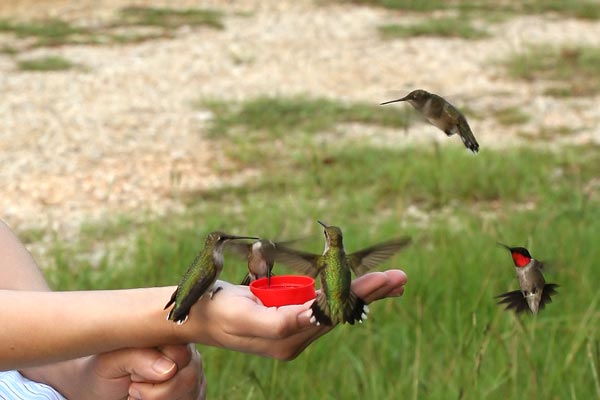
Photos above: This lady lives in a Hummingbird fly zone. As they migrated,
about 20 of them were in her yard. She took the little red dish, filled it with
sugar water and this is the result. The Woman is Abagail Alfano of Pine, Louisiana
- she has been studying them daily and one morning put the cup from the feeder,
with water in it, in her hand; as they had gotten used to her standing by the
feeder they came over to her hand. She says in touching they are as light as
a feather.
Eagle Story - The Power of Healing
 Freedom and I have been together 10 years this summer. She came in as a baby
in 1998 with two broken wings. Her left wing doesn't open all the way even
after surgery, it was broken in 4 places. She's my baby. When Freedom came
in she could not stand. Both wings were broken, her left wing in 4 places.
She was emaciated and covered in lice. We made the decision to give her a chance
at life, so I took her to the vets office. From then on, I was always around
her. We had her in a huge dog carrier with the top off, and it was loaded up
with shredded newspaper for her to lay in. I used to sit and talk to her, urging
her to live, to fight; and she would lay there looking at me with those big
brown eyes. We also had to tube feed her for weeks.
Freedom and I have been together 10 years this summer. She came in as a baby
in 1998 with two broken wings. Her left wing doesn't open all the way even
after surgery, it was broken in 4 places. She's my baby. When Freedom came
in she could not stand. Both wings were broken, her left wing in 4 places.
She was emaciated and covered in lice. We made the decision to give her a chance
at life, so I took her to the vets office. From then on, I was always around
her. We had her in a huge dog carrier with the top off, and it was loaded up
with shredded newspaper for her to lay in. I used to sit and talk to her, urging
her to live, to fight; and she would lay there looking at me with those big
brown eyes. We also had to tube feed her for weeks.
This went on for 4-6 weeks, and by then she still couldn't stand. It got
to the point where the decision was made to euthanize her if she couldn't stand
in a week. You know you don't want to cross that line between torture and rehab,
and it looked like death was winning. She was going to be put down that Friday,
and I was supposed to come in on that Thursday afternoon. I didn't want to go
to the center that Thursday, because I couldn't bear the thought of her being
euthanized; but I went anyway, and when I walked in everyone was grinning from
ear to ear. I went immediately back to her dowl cage; and there she was, standing
on her own, a big beautiful eagle. She was ready to live. I was just about in
tears by then. That was a very good day.
We knew she could never fly, so the director asked me to glove train her.
I got her used to the glove, and then to jesses, and we started doing education
programs for schools in western Washington. We wound up in the newspapers, radio
(believe it or not) and some TV. Miracle Pets even did a show about us. In the
spring of 2000, I was diagnosed with non-hodgkins lymphoma. I had stage 3, which
is not good (one major organ plus everywhere), so I wound up doing 8 months
of chemo. Lost the hair - the whole bit. I missed a lot of work. When I felt
good enough, I would go to Sarvey and take Freedom out for walks. Freedom would
also come to me in my dreams and help me fight the cancer. This happened time
and time again.
 Fast forward to November 2000, the day after Thanksgiving, I went in for
my last checkup. I was told that if the cancer was not all gone after 8 rounds
of chemo, then my last option was a stem cell transplant. Anyway, they did the
tests; and I had to come back Monday for the results. I went in Monday, and
I was told that all the cancer was gone.
Fast forward to November 2000, the day after Thanksgiving, I went in for
my last checkup. I was told that if the cancer was not all gone after 8 rounds
of chemo, then my last option was a stem cell transplant. Anyway, they did the
tests; and I had to come back Monday for the results. I went in Monday, and
I was told that all the cancer was gone.
So the first thing I did was get up
to Sarvey and take the big girl out for a walk. It was misty and cold.
I went to her flight and jessed her up, and we went out front to the top of
the hill. I hadn't said a word to Freedom, but somehow she knew. She looked
at me and wrapped both her wings around me to where I could feel them pressing
in on my back (I was engulfed in eagle wings), and she touched my nose with
her beak and stared into my eyes, and we just stood there like that for I don't
know how long. That was a magic moment. We have been soul mates ever since she
came in. This is a very special bird.
On a side note: I have had people who were sick come up to us when we are
out, and Freedom has some kind of hold on them. I once had a guy who was terminal
come up to us and I let him hold her. His knees just about buckled and he swore
he could feel her power coarse through his body. I have so many stories like
that. I never forget the honor I have of being so close to such a magnificent
spirit as Freedoms. Jeff Guidry and Freedom are at Sarvey Wildlife Center
How Birds Use Healing Clay In Nature
 Clay is renowned to have many uses in promoting health in plants, animals and humans. Bentonite,
Pascalite, as well as other types of healing clays, have been used by indigenous
cultures since before recorded history. Clay works on the entire organism. No
part of the body is left untouched by its healing energies, he notes.
Clay is renowned to have many uses in promoting health in plants, animals and humans. Bentonite,
Pascalite, as well as other types of healing clays, have been used by indigenous
cultures since before recorded history. Clay works on the entire organism. No
part of the body is left untouched by its healing energies, he notes.
All these birds, once they landed in the nearby trees, descended to the ground
and-to our astonishment-ate the bare dirt exposed by the landslide. This was
evidently a prized location and a rare opportunity for the birds, as we could
see them approaching from a distance of at least a mile away. Since most of
New Guinea is covered with jungle, and herbs and fallen leaves blanket the ground,
the rare landslide or cut riverbed affords birds their only exposure to large
areas of soil.
But why did the birds want to eat soil in the first place? What good does
it do them? If it's somehow advantageous, why don't more species seek the same
benefits? Of the 140 bird species that we recorded near our camp, we observed
only eight eating soil, all of them plant eaters (consumers of fruit, seeds,
and flowers). Why isn't soil also good for New Guinea's carnivores, or for the
region's dozens of other species of plant-eating birds, such as berry peckers,
flower peckers, and honey eaters?
Actually, eating soil is widespread among animals of many families on all continents.
It's also widespread among people, especially traditional tribal societies.
The Macaw lick in which hundreds of brightly colored macaws and other parrots
congregate to eat the clay which is essential to their digestion making it certainly
one of the world's great wildlife spectacles and the worlds only known Tapir
lick where in the comfort of mattresses and mosquito nets you may watch the
largest of all South American Land Mammals visit a mineral lick. This is truly
one of the world’s great wildlife spectacles as hundreds of Parrots and their
larger relatives, the Macaws, congregate at this traditional locality to eat
the mineral rich clay that is essential to their digestion. We'll use a floating
blind to get close to the birds. The noise alone is incredible and the sight
of these brightly colored birds at the lick is a sight not to be forgotten.
As the lick slows down in midmorning we'll head for Cocha Blanco, an old ox-bow
lake, in search of a family of Giant Otters that canoe around the lake on our
floating looking for other wildlife.
Virtually all species of wild North American hoofed animals, such as bison
and moose, visit licks, as do bears and some small animals, such as rabbits,
squirrels, and woodchucks. Just as in New Guinea, North American licks also
attract parrots and pigeons. Once these included the now-extinct Carolina parakeet,
and today licks are frequented by the still-extant mourning dove and band-tailed
pigeon. Animals have been visiting our licks for tens of thousands of years,
as attested by bones of mammoths, mastodons, ground sloths, and other big extinct
mammals. Wild animals on all other continents
also engage in geophagy. Predominantly, the soil-eating species are herbivores:
antelopes, apes, giraffes, and zebras in Africa; monkeys, peccaries, and tapir
in South America; deer in Europe and Asia; parrots in South America; and butterflies
in many places.
Licks are even more familiar to our domestic livestock. Ranchers find that
feeding selected soils to cows, sheep, goats, and pigs results in improved health,
weight gain, and food intake, plus enhanced food conversion into meat, by 20
percent or more. Montmorillonite/Bentonite clay is renowned for
its natural antibiotic properties
Real salt is a vital nutrient for birds
Farmers place salt-blocks on their pasture so that their livestock and all other
animals can lick the salt to their heart's content.
 An
abundance of the ingredients in unrefined real salt are as synonymous with life
today as they were a billion years ago before single cells appeared here. Lack
of them is synonymous with birth defects, organ failure, decay, diseases, premature
aging and death at a young age. Long before the earth knew pollutants of any
kind, a huge, ancient sea covered what is now North America. Pure, natural salt
was the main ingredient of this sea, and over millions of years, the water in
the sea evaporated, leaving the salt in undisturbed deposits.
An
abundance of the ingredients in unrefined real salt are as synonymous with life
today as they were a billion years ago before single cells appeared here. Lack
of them is synonymous with birth defects, organ failure, decay, diseases, premature
aging and death at a young age. Long before the earth knew pollutants of any
kind, a huge, ancient sea covered what is now North America. Pure, natural salt
was the main ingredient of this sea, and over millions of years, the water in
the sea evaporated, leaving the salt in undisturbed deposits.

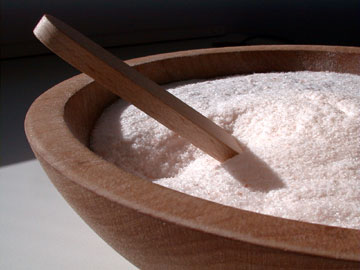
 The
best way to provide salt to your birds is to provide two separate bowls.
One bowl with real-unrefined-unheated-natural-sea-salt
and one bowl without salt, so that the animals can consume as much salt as they
require. They will drink from the bowl that contains salted water, however once
they have had enough salt, they will drink from the bowl that has plain water.
The
best way to provide salt to your birds is to provide two separate bowls.
One bowl with real-unrefined-unheated-natural-sea-salt
and one bowl without salt, so that the animals can consume as much salt as they
require. They will drink from the bowl that contains salted water, however once
they have had enough salt, they will drink from the bowl that has plain water.
From the Bee Hive for your Bird's Health
Bee pollen is often referred to as nature's most complete food. Human consumption
of bee pollen is praised in the Bible, other religious books, and ancient Chinese
and Egyptian texts. It has long been prescribed by traditional health practitioners-including
the fathers of Western medicine Hippocrates, Pliny the Elder, and Pythagoras-for
its healing properties. Bee pollen rejuvenates your body, stimulates organs
and glands, enhances vitality, and brings about a longer life span. Bee pollen's ability to consistently
and noticeably increase energy levels makes it a favorite substance among many
world class athletes and those interested in sustaining and enhancing quality
performance.
Note from Shirley:
A friend had a sickly cockapoo. He was rapidly cured with the following which was added to his food:
- A few drops of linseed oil
- A little bee pollen
- A pinch of pascalite and bentonite clay
- A pinch of real salt (not table
salt)
- Wheatgrass
Wheatgrass for Birds
Companion birds use their beaks to squeeze the delicious, nutritious
juice from each blade, then discard the indigestible part. Pet Grass may help
distract birds that have a feather-picking problem. Be sure to remove the tag
before placing Pet Grass in your bird's cage. They love to chew on the tag,
and some will even chew on the container. You may want to remove the grass from
the container if this is a problem, or clip a small amount of grass to the side
of the cage. Pet Grass can also be chopped up and added to their food.
Homeopathy for Psychological and Hormonal Disorders
by Christopher Day MA VetMB CertIAVH VetFFHom MRCVS
Birds are very prone to Psychological and Hormonal Disorders, there often
being a combination of these factors present in disease.
For example:
- Aconitum will prove invaluable in cases of panic or shock,
- Ignatia could be used where a bird is excitable and suffering from lack
of or loss of a mate or from being moved or separated,
- Staphisagria can be given if the bird is morose and unable to cope with
the conditions in which it is being kept and may start feather-pecking,
- Glonoinium should be considered if the bird has been overheated or if
its cage has been left in an exposed sunny position in a window for too
long,
- Sulphur is indicated where the bird may be suffering feather damage
from general overheating in the room or aviary.
These few examples are but a guide to the usefulness and scope of
veterinary homeopathy, in so many of the common
and troublesome problems in birds. Homeopathy may also, interestingly, prove
of immense value in flocks of chickens, turkeys, ducks or geese, which are intensively
reared. However, this is a specialist subject, requiring help from an experienced
veterinarian, and is not the main subject of this article.
Avian Health Problems and Their Natural Treatments
Gloria Dodd DVM
- Homeopathics are primarily used in cases of psychological
feather picking in the practice of Dr. Joel Murphy* of Clearwater, FL
- Regurgitation and diarrhea can be due to pesticide and herbicide contamination
of the seeds and greens used during growing. I'd assume probable pesticide
poisoning and treat accordingly along with possible bacterial (Salmonella)
infection, because I have seen this so frequently in birds.
- Respiratory conditions and allergies are very common, and can be due to infections,
parasites and stress. It takes a specially trained veterinarian
in avian medicine to help. Relief can be afforded with some homeopathic
remedies
- Egg-Bound problems of female birds. Egg-bound (caged female, unsteady
on perch, ruffled feathers, wagging or straining movements with tail, back
and forth from nest, or standing on floor of cage, even resting on the tail
with legs apart.) This condition can cause acute death due to compression
of large blood vessels or intestinal and ureteral (tubes carrying urine
from the kidneys) blockage. Inspection of the cloacal opening (common opening
for the urine and feces) is evident.
- Ecto-parasites (mites, etc.) can be controlled by good sanitation, cleaning
feathers and other debris daily from the cage and replacing with fresh
newspaper linings. A light dusting of the bird’s feathers with non-toxic
diatomaceous earth weekly will kill what adult parasites are there as well
as their immature forms without poisoning your pets
with the more toxic commercial products
- Wounds can be cleaned externally with warm soapy water, and then dressed
with Calendula ointment on a Q- tip daily as needed.
- Dangers of chemically polluted water.
Other than trauma, almost 90 percent of the emergencies
that befall birds are related to nutrition. Malnutrition, and contaminated,
polluted feed and water with pesticides, and heavy metals.
Parrots and Other Birds Die From...
- Overheated non-stick cookware
- Air fresheners (especially plug-ins)
- Aerosol sprays (many types can kill a parrot including hairspray, paint,
shoe dyes, water repellents, household cleaners, insect sprays[killers,
repellents,flea spray, etc.])
- Finger nail polish and remover
Carolyn Swicegood writes that it is a well-known fact that parrots are especially sensitive to environmental
toxins. Chemicals that normally are only irritating to humans and other animals
can be acutely toxic to parrots. The inhalation of carbon monoxide exhaust or
fumes from overheated Teflon products, which would cause no apparent damage
to humans or other animals, can be fatal to parrots. Their immune systems constantly
are challenged by air pollution, exposure to heavy
metals, water contamination and the adulteration of their foods by pesticides.
A shocking four million tons of pesticides, numbering 20,000 different products,
are fogged into the air in the United States each year! We must control additional
exposure of our birds to these products by not using any fumigants in their
presence. Similarly we must educate ourselves as to the level of contamination
of the foods that they consume.
In the mid-1990s, American biologists used satellite tracking to follow Swainson’s
hawks to their wintering grounds in Argentina, where thousands of them were
found dead from monocrotophos poisoning. Migratory songbirds like bobolinks,
barn swallows and Eastern kingbirds are suffering mysterious population declines,
and pesticides may well be to blame. A single application of a highly toxic
pesticide to a field can kill seven to 25 songbirds per acre. About half the
birds that researchers capture after such spraying are found to suffer from
severely depressed neurological function.
Migratory birds, modern-day canaries in the coal mine, reveal an environmental
problem hidden to consumers. Testing by the United States Food and Drug Administration
shows that fruits and vegetables imported from Latin America are three times
as likely to violate Environmental Protection Agency standards for pesticide
residues as the same foods grown in the United States. Some but not all pesticide
residues can be removed by washing or peeling produce, but tests by the Centers
for Disease Control show that most Americans carry traces of pesticides in their
blood. American consumers can discourage this poisoning by avoiding foods that
are bad for the environment, bad for farmers in Latin America and, in the worst
cases, bad for their own families.
What should you put on your bird-friendly grocery list? Organic coffee, for
one thing. Most mass-produced coffee is grown in open fields heavily treated
with fertilizers, herbicides, fungicides and insecticides. In contrast, traditional
small coffee farmers grow their beans under a canopy of tropical trees, which
provide shade and essential nitrogen, and fertilize their soil naturally with
leaf litter. Their organic, fair-trade coffee is now available in many coffee
shops and supermarkets, and it is recommended by the Audubon Society, the American
Bird Conservancy and the Smithsonian Migratory Bird Center. Organic bananas
should also be on your list. Bananas are typically grown with one of the highest
pesticide loads of any tropical crop. Although bananas present little risk of
pesticide ingestion to the consumer, the environment where they are grown is
heavily contaminated.
What else Parrots
Die From...
Bird Lovers, you need to know about The Realities of Hen Hell
Many people are now aware of the deplorable conditions in which livestock
are forced to live and die in our nation's factory farms. For example, chickens
are forced to live in such crowded conditions that they must be de-beaked to
prevent them from pecking each other to death. Now, another torture inflicted
on farm animals is undergoing scrutiny. According to the U.S. Department of
Agriculture (USDA), at any given time more than 6 million hens in the U.S. are
being systematically starved in their cages. The motive, of course, is money.
Farmers starve hens in a practice called forced molting in order to increase
egg production and raise profits. A 1997 survey of 15 major egg farms revealed
that all routinely withheld or reduced their hens' feed from an average of seven
to ten days. During the process the starving hens are so desperate for nutrition
that they pluck and eat each other's feathers in a desperate attempt to quell
their gnawing hunger. Up to 10% of birds die during forced molting.
Forced molting may have human health consequences. Prolonged food deprivation
weakens the hens' immune systems, increasing the likelihood of salmonella infection.
The pathogens may then be passed to humans eating contaminated eggs or meat.
England banned forced molting in 1987, but the practice continues in the
U.S., supported by the American Veterinary Medical Association. Based on information
in: The Animals' Agenda, Jul-Aug 1998.