Adverse effects from Animal Vaccination
Dr. Ronald D. Schultz, Ph.D..- "Annual re-vaccination provides
no benefit and may increase the risk for adverse reactions. The percentage of vaccinated animals
(those vaccinated only as puppies) protected from clinical disease
after challenge with canine distemper virus, canine parvovirus and
canine adenovirus in the study was greater than 95%."
Dr. Charles E Loops DVM -
"The first thing that must change with
routine vaccinations is the myth that vaccines are not harmful.
Veterinarians and animal guardians have to come to realize that
they are not protecting animals from disease by annual vaccinations,
but in fact, are destroying the vitality and defense systems of these
same animals they love and care for. Homeopathic veterinarians and
other holistic practitioners have maintained for some time that
vaccinations do more harm than they provide benefits. Vaccinations
represent a major assault on the animal's immune system.
Vaccine induced chronic diseases range from life-threatening
conditions such as auto-immune crises to conditions destroying the
quality of life of an animal as in chronic skin allergies."
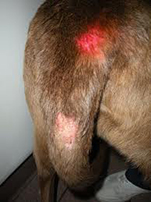 Dee Blanco, D.V.M - "You take healthy animals and often very quickly after you vaccinate, you can see simple
things like itching of the skin or excessive licking of the paws sometimes
even with no eruptions and licking of the air. We see a lot of epilepsy/seizure, often after a rabies vaccination. Or
dogs or cats can become aggressive for several days. Frequently, you'll see urinary tract infections
in cats, often within three months after their
[annual] vaccination. If you step back, open your mind and heart, you'll start to see
patterns of illness post-vaccination." See vaccinosis symptom of severe inflammation of the tail.
Dee Blanco, D.V.M - "You take healthy animals and often very quickly after you vaccinate, you can see simple
things like itching of the skin or excessive licking of the paws sometimes
even with no eruptions and licking of the air. We see a lot of epilepsy/seizure, often after a rabies vaccination. Or
dogs or cats can become aggressive for several days. Frequently, you'll see urinary tract infections
in cats, often within three months after their
[annual] vaccination. If you step back, open your mind and heart, you'll start to see
patterns of illness post-vaccination." See vaccinosis symptom of severe inflammation of the tail.

Dr. Donna Kelleher, a Seattle-based veterinarian who uses
acupuncture and chiropractic, says that improving an animal’s immune system will negate the need for
most vaccines. Vaccines, she says, have been shown to cause auto-immune diseases.
“I feel they may be responsible for arthritis, skin, liver
and kidney problems as well.”
Related:
Covid-19: Uncensored Medical Information
Are We Vaccinating Too Much?
Dr. Dennis Macy DVM - "We should not allow politics and tradition
or greed to enter the decision (on frequency of vaccination). Changing
vaccination schedules doesn't have to mean less profit, but that
you have more income from some clients and less from others. Veterinarians
and the industry need to have guts to be honest with ourselves and
assess the risk and not be trapped in tradition."
Dr. Christina Chambreau, DVM - "Routine vaccinations are probably the
worst thing that we do for our animals. They cause
all types of illnesses and harm but not directly to where we would relate
them definitely to be caused by the vaccine. Repeating vaccinations
on a yearly basis undermines the whole energetic well-being of our
animals. Animals do not seem to be decimated by one or two vaccines
when they are young and veterinary immunologists tell us that viral
vaccines need only be given once or twice in an animal's life. First,
there is no need for annual vaccinations and, second, they definitely
cause chronic disease. As a homeopath, it is almost impossible
to cure an animal without first addressing the problems that vaccines
have caused to the animal, no matter what the species."
1 in 10 Risk of Adverse Reactions from Vaccines
Journal of the American Veterinary Medical Association - Adverse events
diagnosed within three days of
vaccine administration in dogs study of more than 2,000 cats and dogs in the United Kingdom by
Canine Health Concern showed a 1 in 10 risk of adverse reactions
from vaccines. This contradicts what the vaccine manufacturers report
for rates of adverse reactions, which is “less than 15 adverse reactions
in 100,000 animals vaccinated” (0.015 percent). Additionally, adverse
reactions of small breeds are 10 times higher than large breeds,
suggesting standard vaccine doses are too high for smaller animals.
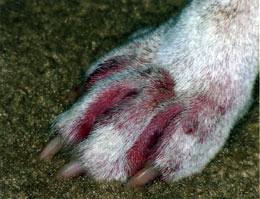 A great number of studies have shown that when you vaccinate
an animal, the body's inflammatory cytokines not only increase dramatically,
but so do the brain's inflammatory chemicals. Many pet guardians
observe changes in a pet subsequent to the first series of animal
vaccinations - obsessive licking of painful inflammed paws, lethargy, vomiting, itching, ear or eye discharge,
to name but a few. The veterinarian will reassure you that these
symptoms are normal. Sadly, for some companion animals, these symptoms
worsen and lead to death. For other pets, they lead to a lifetime
of health problems.
A great number of studies have shown that when you vaccinate
an animal, the body's inflammatory cytokines not only increase dramatically,
but so do the brain's inflammatory chemicals. Many pet guardians
observe changes in a pet subsequent to the first series of animal
vaccinations - obsessive licking of painful inflammed paws, lethargy, vomiting, itching, ear or eye discharge,
to name but a few. The veterinarian will reassure you that these
symptoms are normal. Sadly, for some companion animals, these symptoms
worsen and lead to death. For other pets, they lead to a lifetime
of health problems.
Vaccines are making our dogs sick as vets cash in' Profit-hungry drug companies and vets are 'frightening' dog owners into inoculating
their pets more often than necessary, according to Canine Health Concern. Some puppies have developed conditions including autism
and epilepsy after a raft of injections, it warns.
 Dr. Richard H. Pitcairn, D.V.M., Ph.D - "For some readers the very idea
that vaccines are anything but wonderful and life-saving
may come as a surprise, and it's not a very pleasant one."
Dr. Richard H. Pitcairn, D.V.M., Ph.D - "For some readers the very idea
that vaccines are anything but wonderful and life-saving
may come as a surprise, and it's not a very pleasant one."
Dr. Blanco DVM notes that while more and more health care providers
become enlightened and refuse to vaccinate their kids and patients,
they often forget about their animals. This seminar will be a reminder
that the animals are under a huge assault with vaccinations. Dr.
Blanco will expose the trade off of using dangerous vaccines against
acute disease verses the risk of increased chronic, debilitating
disease. She will analyze the dangers of toxic vaccine ingredients such
as thimerisol, aluminum and formaldehyde and the related disorders
of behavior including ADHD-like tendencies, aggression, seizures,
chronic distemper, chronic parvo and chronic rabies.
She will also give recommendations for using vaccines in the safest manner (only
where required by law), not using vaccines at all or using homeopathic nosodes. Dr. Blanco will show
how the historical model of small pox vaccinations and their following diseases gave much information to the
homeopathic treatment of vaccine induced illness - the model she uses daily. She will also
explore the lack of animal rights in medicine and vaccines specifically.
In 1997 Canine Health Concern conducted a survey on 4000 dogs and found that 61.5% of dogs developed
liver failure within three months of being vaccinated ,73.1% of epileptic dogs
first became epileptic within three months of being vaccinated, 64.9%
of dogs with behavioral problems started to be a problem within three months of vaccination.

Hypertrophic Osteodystrophy (HOD)
 Hypertrophic osteodystrophy causes lameness and extreme pain in
young growing dogs, usually of a large breed. Great danes, German
shepherds, Dobermans, Detrievers and Weimaraners are examples of
breeds that may be affected by this condition. It appears to occur
in Weimaraners as a vaccine reaction and this may also affect
Mastiffs and Great Danes. In this case, it usually occurs a few
days after vaccination and may appear to be worse than the "average"
case on radiographs.
Hypertrophic osteodystrophy causes lameness and extreme pain in
young growing dogs, usually of a large breed. Great danes, German
shepherds, Dobermans, Detrievers and Weimaraners are examples of
breeds that may be affected by this condition. It appears to occur
in Weimaraners as a vaccine reaction and this may also affect
Mastiffs and Great Danes. In this case, it usually occurs a few
days after vaccination and may appear to be worse than the "average"
case on radiographs.
They usually have painful swellings around the lower joints on the legs. HOD usually
shows up as an acute lameness, often seeming to affect
all four legs simultaneously. Affected dogs may stand in a "hunched
up" stance or refuse to stand up at all. They may have a fever but
this is not consistently present. Some puppies will die from
this disease, some suffer permanent disability but many recover later.
The disease is so painful that many owners elect to euthanize
the puppy rather than watch it suffer, despite the reasonably good
chance for recovery, long term. Affected dogs may be so ill that
they refuse to eat.
Pre-vaccination Protection
Dr. Falconer DVM
I get this question more often than I used to: “If I’m not vaccinating
my animal against parvo and distemper (or ----) do I need to avoid
contact with other animals?” The norm has been for my patients to
come to me already vaccinated, so the easy answer, based on duration
of immunity, was no, the immunity should persist for “years if not
the life of the animal.” Now that people have thought more
about the dangers of vaccination, it may be that some are choosing not
to vaccinate until later in life (pups at 12-16 weeks old, for example),
to be sure the minimum number of vaccines will give long-lived immunity.
They may be using homeopathic nosodes remedies
before that, or may be opting to not vaccinate at all. What to do
for these guys? Keep them in a bubble, away from all exposure to
possible disease causing germs? No. That’s impractical, and, unless
you have a strictly indoor cat, not much fun.
I use a variety of
natural remedies to improve my animal's health
and to protect the integrity of their immune system
Many of the natural healing remedies
I use at home to help treat my dogs are:
Nuvet, Wheat grass juice,
Stem Cell Nutrition, Clay, Plankton, are listed in the
product page I also use
a unique immune booster mentioned in this page
(To close this message, click anywhere on the page.)
The goal is to have an immune system that can defend the animal
against exposure to parvo, canine or feline distemper, kennel cough,
FeLV, strangles, flu, Rhino, etc. If you opt to have the strongest
defense system possible without the risks that vaccines confer, use
the preventative program that keeps the disease resistance strong safely
and efficaciously, and without risk to the animal. That, in my opinion,
is daily dosing with the Animal Health supplements utilizing
a product that boost the immune system, coupled with excellent nutrition should be an adequate support.
Question to Dr. Falconer:: does vaccination (or over-vaccination)
causes overactive immune reaction (autoimmune disorder) or does
it cause suppression of the immune system?
Dr. Will Falconer D.V.M:
"The answer is YES. Probably both. Vaccination *confuses* the immune
system, as I point out in my heart` worm eBook. So, it could go either way, or alternate over time between
the two. There is a natural nutritional product that help support the animal's immune
system. A healthy immune system is capable of helping the body heal
itself. This immune supplement should be given before and immediately after
vaccination for at least a few weeks to help ameliorate the confusion
(when someone is faced with a mandatory vaccination, or has decided
they want to give one) and protect the integrity of the defense system. "
Adverse Reactions From Rabies Immunizations
 World-renown vaccine research scientist and practicing veterinarian,
Dr. W. Jean Dodds of California, and pet vaccine disclosure advocate, Kris
L. Christine of Maine, have established The Rabies Challenge Fund to raise
money to fund a 7 year rabies vaccine challenge study in the United States.
Many dog caregivers across the country are becoming more and more aware
of the possibility that over vaccination can have harmful effects on dogs
- and the rabies vaccine is no exception. The incidence of rabies exposure
in companion animals and humans, though very low today, still remains a
distinct possibility.
World-renown vaccine research scientist and practicing veterinarian,
Dr. W. Jean Dodds of California, and pet vaccine disclosure advocate, Kris
L. Christine of Maine, have established The Rabies Challenge Fund to raise
money to fund a 7 year rabies vaccine challenge study in the United States.
Many dog caregivers across the country are becoming more and more aware
of the possibility that over vaccination can have harmful effects on dogs
- and the rabies vaccine is no exception. The incidence of rabies exposure
in companion animals and humans, though very low today, still remains a
distinct possibility.
Consequently, the Federal and state governments require
every dog to be vaccinated triennially (still even annually or biannually
in a few states) against rabies. However, the veterinary community is increasingly
concerned that rabies vaccination given this frequently is not only unnecessary
but also responsible for inducing adverse reactions that lead to both acute
and chronic immunological and other disorders. Although a French medical
study completed in 1992 showed that rabies vaccine is protective for at
least five years, Federal and state legislatures have not accepted this
finding. Thus, the health and well-being of millions of dogs in the United
States remain threatened by the potential for adverse vaccinial events.
A Cat, a Bat and Rabies Vaccination
In her story, A Cat, a Bat and Rabies Vaccination, Kimberly Roush writes
that the risk of side effects from the vaccines is frightening, but nothing is a scary as the state coming to
confiscate your cat and possibly chop off his head. This summer, in Utah, there were at least 3 stories in the
news of cats having had some contact with bats that were only overdue for a rabies vaccines.
All of the cats were put to sleep as no one was willing to pay for the cost of a 6 month quarantine.
I believe over 300 animals in Utah were put to sleep in 2007 because of bat encounters and lack of or late vaccines.
But in her heart-wrenching story, Karen Blackburn describes how she managed to save her dog's life when he suffered a
life-threatening reaction after receiving a vaccination for rabies.
THE BIG SCAM--RABIES VACCINATION
By: Dr. John Fudens, D.V.M.
 "
All mandatory rabies vaccination programs are colorable law,
in that they have been passed and mandated upon the pet owning public
by certain vested interest groups. Who are these groups? First and
foremost are veterinarians, in general, and veterinarian medical
organizations. Second are the local animal control personnel, bureaucrats
and politicians. What are their reasons? GREED, POWER AND CONTROL.
Both these large powerful interest groups stand to benefit greatly
by having rabies mandated by colorable law."
"
All mandatory rabies vaccination programs are colorable law,
in that they have been passed and mandated upon the pet owning public
by certain vested interest groups. Who are these groups? First and
foremost are veterinarians, in general, and veterinarian medical
organizations. Second are the local animal control personnel, bureaucrats
and politicians. What are their reasons? GREED, POWER AND CONTROL.
Both these large powerful interest groups stand to benefit greatly
by having rabies mandated by colorable law."
"Veterinarians receive a large percentage of both their gross
income and profit from vaccines given in the office. On average
vaccines cost 60 to 95 cents per dose and are charged to the client
at $15 to $25 per injection and substantially more in the large
cities. Therefore, if veterinarians lobby to have a colorable law
passed to give rabies vaccine every year that enhances their financial
picture."
"The vaccines, particularly rabies, are a political and economic
scam being forced upon pet owners because they do not know the truth."
All Veterinary Schools in North America Changing Vaccination Protocols
Recent editions of the Senior Dogs Project's newsletter
have reported on the ever-broadening trend of eliminating vaccinations for adult
dogs, except for rabies, where required by state law. We have now
had a report that all 27 veterinary schools in North America are
in the process of changing their protocols for vaccinating dogs
and cats. Here, in a nutshell, are the new guidelines under consideration:
"Dogs and cats immune systems mature fully at 6 months. If a modified
live virus (MLV) vaccine is given after 6 months of age, it produces
immunity, which is good for the life of the pet (i.e., canine distemper,
parvo, feline distemper). If another MLV vaccine is given a year
later, the antibodies from the first vaccine neutralize the antigens
of the second vaccine and there is little or no effect. The
titer is not 'boosted' nor are more memory cells induced.
"Not only are annual boosters for parvo and distemper unnecessary,
they subject the pet to potential risks of allergic reactions and
immune-mediated hemolytic anemia. There is no scientific documentation
to back up label claims for annual administration of MLV vaccines.
Puppies receive antibodies through their mothers milk. This natural
protection can last 8-14 weeks. Puppies and kittens should NOT be
vaccinated at LESS than 8 weeks. Maternal immunity will neutralize
the vaccine and little protection (0-38%) will be produced. Vaccination
at 6 weeks will, however, delay the timing of the first highly effective
vaccine. Vaccinations given 2 weeks apart suppress rather than stimulate
the immune system. A series of vaccinations is given starting at
8 weeks and given 3-4 weeks apart up to 16 weeks of age. Another
vaccination given sometime after 6 months of age (usually at 1 year
4 months) will provide lifetime immunity."
Illness occurring after Immunizations
Chrissie Mason B.R.C.P., Ph.D. - "I am becoming seriously
concerned at the increase in the cases of Auto-immune disease, and
the Canine/Feline vaccination program which I consider to be inextricably
linked. Certainly, I do not stand alone in holding these views,
as a number of Orthodox Veterinary Practitioners have expressed
their concern over the incidence of certain types of illness suddenly
appearing after immunizations have been administered. Often these are severe skin disorders,
gastrointestinal disturbances, sickness and colitis symptoms,
all of which have been observed and recorded.
A further occurrence observed by some Veterinarians is that of a tumor or growth
appearing directly on or around the sight of the annual injection,
this is particularly noticeable in the feline world, and can take
the form of fibrosarcoma.
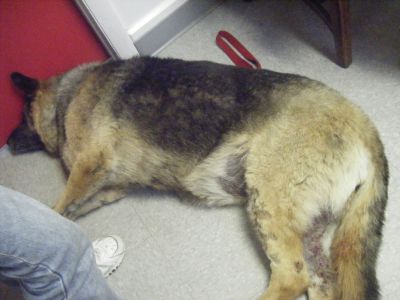 Indeed, the list of symptoms that can be linked with the over exuberant immunizations appears
endless: warty growths, tumors of both malignant and benign
type, seizures, skin problems, bone and joint disorders. In
America the Veterinary Immunologists claim that vaccinations should
only be given once or twice during an animal's life time.
Indeed, the list of symptoms that can be linked with the over exuberant immunizations appears
endless: warty growths, tumors of both malignant and benign
type, seizures, skin problems, bone and joint disorders. In
America the Veterinary Immunologists claim that vaccinations should
only be given once or twice during an animal's life time.
There is no need or evidence to prove that annual vaccination programs
are either essential or effective. On the contrary research suggests
that no dog over the age of 7 years of age derives benefit from
the annual vaccine schedule. Furthermore, those animals submitted
to the annual boosters, go on to display exacerbation of joint related ills in later life."
Avoid Lyme disease, Leptospirosis, and Periodontal Vaccine
Dr.Patricia Jordan, DVM
The leptospirosis portion of the DHLPP (distemper) vaccine for
dogs has a reputation for being the most likely portion to cause
vaccine reactions. This is largely because of the size of the organism.
(Most vaccine is directed against viruses that are barely bigger
than complicated molecules. The leptospirosis organism is a bacterium,
meaning it is enormous and more complicated than any virus. The
more complicated the organism, the more likely the reaction. That
said, in the aforementioned study of over one million dogs, the
leptospirosis vaccine was not found to be more likely to cause a
reaction. This may be because of improved vaccine technology and
using only portions of the organism rather than the entire bacterium.
Other leptospirosis vaccine may not be as well produced as the one
that happened to be used in this study so, as a precaution you can
request that this portion be left out of your dog's vaccine.) The
Lyme disease organism is also a bacterium as is the periodontal
vaccine (the Porphyromonas vaccine). Again, larger vaccine organisms
tend to produce more reactions.
Avoid Giving Several Vaccinations at one Time
Keep in mind that vaccines given within two weeks of each other
can interfere with each other so you do not want to separate vaccines
by less than a two week period but separating vaccine can mean your
pet has less stimulation to deal with at one time. Breaking up vaccines
also helps determine which vaccine is the culprit.
Do Not have your Pet Vaccinated at a Vaccine Clinic
Vaccination clinics are designed to provide streamlined service
for healthy pets in need of their regular immunizations. These clinics
are generally not prepared for the individual attention required
by a pet who has a history of vaccination reaction. A pet with a
vaccine reaction history should receive some special attention in
the form of observation in the hospital and/or pre-treatment with
anti-inflammatory medication.
 Allen M. Schoen, D.V.M., M.S. - "As far as prevention
goes, this is a sticky wicket. There is a great deal of controversy
concerning the dog Lyme vaccine. There is a great debate about how
well they actually work as well as potential side effects. There
are publications concerning its safety, but the researchers only
look 24 hours after the vaccine reaction. Research at Cornell University
veterinary school brings up some suspicion that there may be potential
long term side effects of the vaccine, though nothing is certain.
These side effects may vary from
rheumatoid arthritis and all the
major symptoms of Lyme disease to acute kidney failure. Though nothing
is definitively documented, I personally am very cautious and do
not recommend vaccinating for Lyme disease even though it is so
epidemic here. Many veterinary schools and major veterinary centers
do not recommend the vaccine for the same concern regarding potential
side effects. I have seen all the symptoms of Lyme disease in dogs
four to eight weeks after the vaccine and when I sent the western
blot test to Cornell, it shows no evidence of the disease, only
evidence of the dog having been vaccinated, yet the dog shows all
the classic symptoms of the disease. There is a new dog vaccine
out that claims that it does not have any of the side effects, however,
I still remain cautious and will wait for a year or two to see.
I personally would rather treat my dog for Lyme disease rather than
risking the potential side effects of the vaccine. In addition,
there is a question of actually how well it works. Until more safety
and decreased risk of side effects and efficacy are demonstrated, I recommend holding off."
Allen M. Schoen, D.V.M., M.S. - "As far as prevention
goes, this is a sticky wicket. There is a great deal of controversy
concerning the dog Lyme vaccine. There is a great debate about how
well they actually work as well as potential side effects. There
are publications concerning its safety, but the researchers only
look 24 hours after the vaccine reaction. Research at Cornell University
veterinary school brings up some suspicion that there may be potential
long term side effects of the vaccine, though nothing is certain.
These side effects may vary from
rheumatoid arthritis and all the
major symptoms of Lyme disease to acute kidney failure. Though nothing
is definitively documented, I personally am very cautious and do
not recommend vaccinating for Lyme disease even though it is so
epidemic here. Many veterinary schools and major veterinary centers
do not recommend the vaccine for the same concern regarding potential
side effects. I have seen all the symptoms of Lyme disease in dogs
four to eight weeks after the vaccine and when I sent the western
blot test to Cornell, it shows no evidence of the disease, only
evidence of the dog having been vaccinated, yet the dog shows all
the classic symptoms of the disease. There is a new dog vaccine
out that claims that it does not have any of the side effects, however,
I still remain cautious and will wait for a year or two to see.
I personally would rather treat my dog for Lyme disease rather than
risking the potential side effects of the vaccine. In addition,
there is a question of actually how well it works. Until more safety
and decreased risk of side effects and efficacy are demonstrated, I recommend holding off."
Vaccines; Good Medicine or Bad Advice?
by Russell Swift, DVM
Homeopaths have referred to vaccine induced problems as "vaccinosis"
for decades. From my experience and that of others, I say without
reservation that many chronic diseases are caused by vaccinations.
I often find that a health problem began shortly after vaccination.
I am certain this is no coincidence. Fortunately, homeopathy can
help. Unfortunately, vaccines are a BILLION dollar industry and
vets make a large part of their income from them. Despite the new
findings, there is no move to reduce vaccine use. Most
 use the excuse
that they don't want to be sued should an animal become ill. Another
rationalization is that some pets are not protected despite vaccination
therefore, it is best to vaccinate every pet to be safe. If vets
knew how much damage they were doing, I believe most would change.
There is too much power and money promoting more vaccines. Vets
are inundated with sales people, advertisements and marketing materials
telling them how important and lucrative vaccines are.
use the excuse
that they don't want to be sued should an animal become ill. Another
rationalization is that some pets are not protected despite vaccination
therefore, it is best to vaccinate every pet to be safe. If vets
knew how much damage they were doing, I believe most would change.
There is too much power and money promoting more vaccines. Vets
are inundated with sales people, advertisements and marketing materials
telling them how important and lucrative vaccines are.
Dr. Richard H. Pitcairn, D.V.M., Ph.D - "In the process
of training as a doctor or veterinarian, one goes in as a relatively
naive young person. The conditioning is heavy; it costs a lot of
money, and of course you want to do well. Students are told how
wonderful vaccines are, and they don't really question it; they
accept as a fact that they're these great boons to health, are never
harmful, and have saved a lot of lives—it's black and white. The
companies making the vaccines have great amounts of money and influence
to campaign and advertise. You have a situation on the one hand
where doctors are conditioned to accept, and on the other hand companies
powerful enough to squelch negative comment."
Dr. Driston Sherman, DVM - " When I was doing primary
allopathic medicine, I saw two things. One is that within an hour
after the vaccination was given, the animal was having trouble breathing
or may have had redness of the skin. The other thing I saw quite
often was usually about twelve to twenty-four hours after being
vaccinated, animals with fever, loss of appetite, sleeping a lot,
sometimes vomitting or diarrhea. Most of those cases usually took
care of themselves without any intervention within twenty-four hours.
Now that I'm doing holistic medicine, it's really intriguing to
look at the medical histories of animals. One case that comes to
mind is a cat with a history of these horrible-looking sores that
occurred exactly 30 days after being vaccinated - two years in a
row. You may want to call that coincidence. I have my suspicions
but I can't say , for sure, what caused these conditions, which
is very frustrating."
Veterinary Immunizations are Big Money for Many Vets—and Even Bigger Money for Big Pharma
Without some driving force for change, there is no motivation
for the industry to change the most lucrative part of its practice.
Many vets cling to annual vaccine schedules because of economic
dependence more than maintaining a “cautious” standard of care.
This is particularly true for the typical small vet practices (1-3
people, non-specialty, non-emergency practices).
Consider this… One dose of rabies vaccine costs the vet about
61 cents. The client is typically charged between $15 and $38, plus
a $35 office visit. The markup on the vaccine alone is 2,400 percent
to 6,200 percent—a markup equivalent to charging $217 for a loaf
of bread. According to one estimate, removing the one-year rabies
vaccination and consequential office visit for dogs alone would
decrease the average small vet’s income from $87,000 to $25,000—and
this doesn’t include cats or other vaccinations.
According to James Schwartz, author of Trust Me, I’m Not a Veterinarian,
63 percent of canine and 70 percent of feline vet office visits
are for vaccinations. Clearly, radically changing the vaccine schedule
for dogs and cats would result in a huge economic loss for any veterinary
practice that is built around shots. And chances are the vaccines
you are paying so much for are creating even more income for vets,
because the adverse reactions and other medical issues caused by
the vaccines keep Fluffy coming back often!
The profits for vets pale in comparison to the profits being
enjoyed by vaccine manufacturers. Veterinary vaccine sales amounted
to more than $3.2 million in 2004 and have risen 7 percent per year
since 2000. This figure is projected to exceed $4 billion in 2009.
Six companies account for more than 70percent of world veterinary
vaccine sales. The market leader is Intervet, with sales of almost
$600 million in 2004. That’s a whole lot of 61-cent vaccines. The
United States has by far the largest share of the national market
with revenues of $935 million, and Japan comes in second with $236 million.

My pug, MuShu, almost died twice from routine vaccinations.
MuShu had always been vaccinated and given her booster shots
since she was 8 weeks old. I had done everything my vet had told
me to do. After all, I love my dog and wanted her to have a healthy
happy life. When MuShu was 5 yrs. old, I took her in for her routine
vaccines. I live about 5 min. from my vet clinic and by the time
I got home with her and got into the house, she was scratching herself
like crazy. Even dragging her tummy across the floor and rolling
all around. When I looked at her closer, I saw she had developed
hives all over. She then got up to come to me and could not walk
in a straight line. She vomited and fell over and could not get
up. I grabbed my keys and MuShu and threw her into the car. We practically
flew back to the Vet clinic.
I ran into the office and yelled "my dog is dying!". The vet
tech came out and grabbed her from my arms and went into the back
with her. I was hot on her heels as I was not going to let her out
of my sight. The Dr. came in and administered some benadryl and
told me to stay with her and watch her. They came in and checked
on her every 5 min. or so. After about 1 hour. it seemed the crisis
was over and she was becoming her old self again. I asked the Dr.
what on earth had happened and he said she had a reaction to the
vaccine she was given.
 When I asked him if it would ever happen again, he said probably
not. Little did I know. About 6 mos. later, it was time for MuShu
to have her Rabies vaccine. This is required by law and I thought
I had to comply. I reminded the Vet about her reaction to the last
shots and her told me that there was no way she would have the same
reaction because it was a different shot and carrier in the shot.
With his reassurance, I got MuShu the shot.
When I asked him if it would ever happen again, he said probably
not. Little did I know. About 6 mos. later, it was time for MuShu
to have her Rabies vaccine. This is required by law and I thought
I had to comply. I reminded the Vet about her reaction to the last
shots and her told me that there was no way she would have the same
reaction because it was a different shot and carrier in the shot.
With his reassurance, I got MuShu the shot.
She seemed fine at first but after about an hour later, I saw
the hives and the itching starting all over again. This time the
Vet came over to my house and gave her some benadryl and stayed
to watch her recovery. I have since learned that, armed with a letter
from my vet. I no longer have to get her any vaccines as she is
exempt due to severe reactions. I will never get her another vaccine
again. I keep her healthy and strong by feeding her a raw food diet and giving her
a unique supplement to keep her immune system strong. I also have
another dog, a cat and a horse. All are given the best diet I can
give them and the natural immune enhancing supplement. I do have to give my new dog Rabies
shots, however they are followed up with a homeopathic remedy to
lesson any side affects.
Stop the Shots!
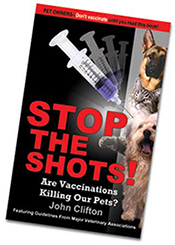 This is an important book for every pet owner to read.
In a conversational, direct, non-technical voice it guides the reader
in formulating an intelligent approach to animal vaccinations. Clifton
lays out all the major issues: whether to vaccinate or not, which
shots to give and which to avoid, how to know if and when a shot
should be repeated. And, importantly, the risks in over-vaccinating.
Holistic as well as orthodox medical opinions are presented. Despite
the title, readers are not advised flat out to abandon vaccinations.
Rather, they are encouraged to learn about the risks and benefits
- and "stop the shots" until they are fully informed. This book tells you: all you need to know about vaccinating and NOT vaccinating
your pet.
This is an important book for every pet owner to read.
In a conversational, direct, non-technical voice it guides the reader
in formulating an intelligent approach to animal vaccinations. Clifton
lays out all the major issues: whether to vaccinate or not, which
shots to give and which to avoid, how to know if and when a shot
should be repeated. And, importantly, the risks in over-vaccinating.
Holistic as well as orthodox medical opinions are presented. Despite
the title, readers are not advised flat out to abandon vaccinations.
Rather, they are encouraged to learn about the risks and benefits
- and "stop the shots" until they are fully informed. This book tells you: all you need to know about vaccinating and NOT vaccinating
your pet.
Veterinary Vaccine Injury Act
It is imperative that veterinarians educate their clients
concerning the associated risks of vaccines. Pet owners
need to make educated decisions regarding the care of their
beloved pets. Standardized handouts describing the benefits
and risks of vaccinations are warranted and should be distributed
by veterinarians to all animal lovers. In addition, standardized
vaccination waivers should also be available for caretakers
whose animals are prone to adverse reactions. This also
applies to animals with chronic health conditions to insure
that caretakers are not penalized for taking the necessary
medical precautions. Truth in Labeling law for Rabies vaccines
is a must . Unbeknown to many animal lovers, and with the
USDA's approval, some three-year rabies vaccines are relabeled
and used as one year products. Pet owners are generally
unaware of the fact that their animals are being over-vaccinated
by receiving a full three-year dose every year. The government,
in cooperation with the veterinary professional community,
should enact and enforce a "standard" set of administrative
guidelines concerning: a). the frequency and location of
any vaccination and b). accurate record keeping for both
feline and canine vaccinations; taking into consideration
each animal's lifestyle, health and age. Veterinarians should
then be held accountable to this "standard of care".
Testimonials about a Dog and a Horse full Recovery from Antagonistic
Effects brought on by Scheduled Immunizations
Recently, my sweet, healthy, 11-year-old German shepherd died
of autoimmune hemolytic anemia. He had no problems until
after his annual Lyme-disease booster. Within a couple of weeks
after that shot, he worsened slowly and continually. Despite expert
medical attention (including transfusions), we couldn't save him.
Canine autoimmune hemolytic anemia. (AIHA) is a disease characterized
by increased destruction of red blood cells (erythrocytes) by the
dog's own defense system. Though much attention has been given recently
to AIHA due to evidence linking the process of vaccinating
with the manifestation of this sometimes life-threatening disease,
immunization is only one potential cause for this condition.
My dog Arnie had been given up on by the vet. He had acute anemia,
a disease characterized by increased destruction of red blood cells
(erythrocytes) by the dog's own protection system, and quite honestly
we were making arrangements for his funeral. After one week on
a unique supplement to support his immune system, we noticed a dramatic
improvement. Three months later, after finishing the entire course,
Arnie is doing so well that he no longer needs the immune supplement .
He now has so much energy on his new diet (James well beloved) that
we have to restrict his intake or we could be pulling him off the
ceiling. He is putting on weight steadily as is his partner Heidi,
She has been on an immune restore supplement also and it has cured her scaly
flaky skin condition on her back. Dave Burrows in Eastbourne, United Kingdom
THE VACCINATION DILEMMA and YOUR HEALTHY COMPANIONS
by Dr Charles E Loops DVM
Homeopathic veterinarians and other holistic practitioners have
maintained for some time that vaccinations do more harm than they
provide benefits. Vaccinations represent a major assault on the
body's defense system. Attenuated organisms or chemically killed
viruses or bacteria are injected directly into the blood stream,
an unnatural route of infection. This profound insult, avoiding
the body's first line of defenses, and flooding the system with
millions of organisms or viral particles, stresses the immune system
in a way not of natures design. This insult causes irregularities
and abnormalities in the disease resistance system which then manifests as chronic
diseases in animals.
These chronic diseases range from life-threatening conditions
such as auto-immune crises to conditions destroying the quality
of life of an animal as in chronic skin allergies. What
we are now seeing are generations of over-vaccinated animals and
these current offspring are suffering the penalty of this medical
abuse. In an attempt to control a naturally occurring process of
population control and survival of the fittest, the medical establishment
has convinced people that mass inoculations are for the good of
all, overlooking the health of the individual. Where vaccinations
have helped in eradicating or reducing the incidence of severe,
acute disease processes, the result has been to plague humanity
with more insidious, chronic diseases that are much more difficult
to treat and that lower the quality of life for many individual
animals and people. In all of this, there needs to be BALANCE, and
the following are my recommendations for vaccinating or not vaccinating
and some comments about diet. 1. Puppies under three months of age
should not be vaccinated. Vaccinations are much more stressful on
the underdeveloped immune system.
 Also, these vaccinations are much less effective at providing
immunity before three months of age. If you feel you must vaccinate,
do so with one vaccination of Distemper at three months, followed
by a vaccination for Parvovirus at four months of age, and stop
with that. If you can't find a single Distemper vaccine use the
Distemper-measles combination. Use killed vaccines only.
Also, these vaccinations are much less effective at providing
immunity before three months of age. If you feel you must vaccinate,
do so with one vaccination of Distemper at three months, followed
by a vaccination for Parvovirus at four months of age, and stop
with that. If you can't find a single Distemper vaccine use the
Distemper-measles combination. Use killed vaccines only.
2. Kittens should only be vaccinated for Panleukopenia and not
before three months of age. All other vaccinations should be avoided.
One vaccine is sufficient.
3. Puppies and kittens can be given homeopathic
nosodes beginning at three weeks of age, if there is a potential
for exposure to Distemper, Parvovirus, or Panleukopenia. These nosodes
can be used until vaccinations are given or continued periodically
for the first year of life, if vaccinations are not given. Common
sense should be used in avoiding exposure of very young animals
to other, possible unhealthy, animals of the same species.
4. Booster vaccinations are completely unnecessary. Studies are
now showing that these vaccinations are effective for many years
and most probably for life. Vaccinated animals do not need any boosters.
Homeopathic nosodes can be given periodically if you are concerned
or if you think your animals live a high risk, life style.
5. Rabies Vaccinations should be given as dictated by state laws.
Lyssin, the homeopathic nosode, should be given within a few hours
after the vaccination. Clearly, the rabies vaccination is effective
for many years more than state laws require booster vaccination.
6. Booster vaccinations can cause SEVERE set-backs when an animal
is being treated homeopathically for chronic problems. They can
completely erase any progress that has been made towards improving
an animal's health.
7. My personal recommendation is NOT to vaccinate at all. The
best road to good health is feeding a diet rich in fresh foods,
raw meats for the carnivores, and avoiding vaccinations and allopathic
medications. Antibiotics and other allopathic drugs should only be
used in situations where their use is clearly indicated, and this
should be only in potentially, life-threatening situations. Every
time you suppress a symptom the body produces, you are potentially
lowering the health status of the body system. Treating with the
correctly prescribed, homeopathic remedy, herbs, or other non-invasive
therapies, not of a chemical nature, will enhance your health and
your companions health.
- 1. Puppies under three months of age should not be vaccinated.
- 2. Kittens should only be vaccinated for Panleukopenia and
not before three months of age.
- 3. Puppies and kittens can be given homeopathic nosodes
beginning at three weeks of age
- 4. Booster vaccinations are completely unnecessary.
- 7. My personal recommendation is NOT to vaccinate at all
(Click the headline for details)
WHAT VETS DON'T TELL YOU ABOUT VACCINES
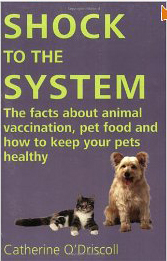
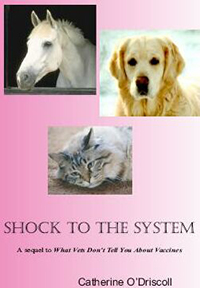 'Shock
to the System by Catherine O’Driscoll is a sequel to 'What
Vets Don't Tell You About Vaccines'. It covers the latest information
on the vaccine issue, and puts the other pieces of the puzzle into
the picture. Diet, environmental toxins, pharmaceuticals and stress
all play a part in the health of companion animals. This book will
make you cry and aware of the scam that is the mainstay of the veterinary
field. It is well researched and written. The truth about the terrible
suffering of pets and their owners and what can be done to protect
your animals from the drug companies and ignorant vets. This information
can save your animals and give you the facts to present to your
vet if he/she does not keep up with current science. A must for
anyone who loves animals and wants to keep them safe and healthy.
'Shock
to the System by Catherine O’Driscoll is a sequel to 'What
Vets Don't Tell You About Vaccines'. It covers the latest information
on the vaccine issue, and puts the other pieces of the puzzle into
the picture. Diet, environmental toxins, pharmaceuticals and stress
all play a part in the health of companion animals. This book will
make you cry and aware of the scam that is the mainstay of the veterinary
field. It is well researched and written. The truth about the terrible
suffering of pets and their owners and what can be done to protect
your animals from the drug companies and ignorant vets. This information
can save your animals and give you the facts to present to your
vet if he/she does not keep up with current science. A must for
anyone who loves animals and wants to keep them safe and healthy.
Catherine O'Driscoll is the founder of Canine Health Concern in the UK. Canine Health Concern offers a certified
study program – the Foundation in Canine Health care – to help
you to take good care of your dogs. This program also has another
aim, and this is to build a worldwide network of Animal Advocates
– people who understand the scientific and experiential facts about
canine health care, and who are not influenced by the advertising
propaganda of big business.
Vets are, sadly, educated in colleges which must accept funding
from commercial concerns. Often this funding is given on the understanding
that the sponsor’s commercial message is respected within the curriculum.
For example, ask your vet how many hours or days were spent discussing
canine dietary requirements, and whether the lecturer was independent
of commercial propaganda or, indeed, whether the lecturer was an
employee of a pet food company. You will find the answers somewhat
disconcerting. Become, instead, your own expert – and enjoy life
with your animal friends, without constantly having to tend to illnesses.
Canine Health Concern’s educational program is based upon ten
years of research; our work is sufficiently credible to be featured
in a prime time TV documentary – World in Action. Catherine O’Driscoll’s
book, ‘What Vets Don’t Tell You About Vaccines’ is an official best-seller
that forms the basis of continuing research in the scientific and
veterinary communities.
Since 1994, Canine Health Concern (CHC) has been exposing the truth about the influence
of big business on your pets, so that your dogs can live long and healthy lives.
Viera Scheibner, PhD - "I did not find it difficult to conclude
that there is no evidence whatsoever that vaccines or any kind are
effective in preventing the infectious diseases they are supposed
to prevent. Further, adverse effects are amply documented and are
far more significant to public health than any adverse effects of
infectious diseases. Immunizations not only did not prevent any
infectious diseases, they caused more suffering and more deaths
than has any other human activity n the entire history of medical
intervention. It will be decades before the mopping-up after the
disasters caused by childhood vaccination will be completed. "
Immunizations in Veterinary Medicine: Dogs and Cats
by Don Hamilton, DVM
 A practice that was started many years ago and that lacks scientific
validity or verification is annual re-vaccinations. Almost without
exception there is no immunologic requirement for annual revaccinations.
Immunity to viruses persists for years or for the life of the animal.
Successful vaccination to most bacterial pathogens produces an immunologic
memory that remains for years, allowing an animal to develop a protective
anamnestic (secondary) response when exposed to virulent organisms.
Only the immune response to toxins requires boosters (e.g. tetanus
toxin booster, in humans, is recommended once every 7-10 years).
And no toxin vaccines are currently used for dogs and cats. Furthermore,
revaccination with most viral vaccines fails to stimulate an anamnestic
(secondary) response as a result of interference by existing antibody
(similar to maternal antibody interference). The practice of annual
vaccination in our opinion should be considered of questionable
efficacy unless it is used as a mechanism to provide an annual physical
examination or is required by law (i.e., certain states require annual revaccination for rabies).
A practice that was started many years ago and that lacks scientific
validity or verification is annual re-vaccinations. Almost without
exception there is no immunologic requirement for annual revaccinations.
Immunity to viruses persists for years or for the life of the animal.
Successful vaccination to most bacterial pathogens produces an immunologic
memory that remains for years, allowing an animal to develop a protective
anamnestic (secondary) response when exposed to virulent organisms.
Only the immune response to toxins requires boosters (e.g. tetanus
toxin booster, in humans, is recommended once every 7-10 years).
And no toxin vaccines are currently used for dogs and cats. Furthermore,
revaccination with most viral vaccines fails to stimulate an anamnestic
(secondary) response as a result of interference by existing antibody
(similar to maternal antibody interference). The practice of annual
vaccination in our opinion should be considered of questionable
efficacy unless it is used as a mechanism to provide an annual physical
examination or is required by law (i.e., certain states require annual revaccination for rabies).
Over Vaccinating
"This morning I ran into a frantic lady, who recently lost her 5
yr. old dachsie, (died of complications due to back paralysis),
which she claimed was due to having her dog vaccinated for rabies
every year. She said she once worked for a Vet, and said she also
had pamphlets that claim many vets over vaccinate these small dogs
for the sake of making extra $$$$. She also said this breed is far
too small to intake yearly vaccinations and this will eventually
paralyze them as it did hers."
TAKE THE TITER TEST Testing a dog’s serum antibody titers
can prevent over vaccinating. Taking blood for an annual titer test,
to check a dog’s level of immune defenses, should replace the habit
of vaccinating dogs annually whether or not they need it.
VACCINATING DOGS AND CATS
T J Dunn, Jr. DVM
If you choose to vaccinate your own dog or cat, there are a few
things you should consider first. Remember...any animal could have
an adverse reaction to any vaccine. The probability is small, but
if it happens, your pet could be in big trouble...fast! Adverse
reactions from vaccinations are rare but do happen. The worst case
scenario occurs when the dog or cat has what is termed an ANAPHYLACTIC
REACTION. These hypersensitivity reactions cause a number of physiologic
disturbances within the body that result in low blood pressure,
slow heart rate and depressed breathing rate. The pet goes into a SHOCK REACTION...