Understanding your Baby's Needs
 Attachment parenting focuses on the nurturing connection that parents can develop with their children.
Your baby's need seek maximum skin to skin touching. Ways to achieve that include joint baths and
"baby-wearing" such as carrying babies in a sling.
Attachment parenting focuses on the nurturing connection that parents can develop with their children.
Your baby's need seek maximum skin to skin touching. Ways to achieve that include joint baths and
"baby-wearing" such as carrying babies in a sling.
Co-sleeping is when an infant sleeps in the same room with parents so they can feed and emotionally soothe
the child during the night. Sleeping in the same bed with babies is an age old common practice world-wide.
The American Academy of Pediatrics (AAP) claims that co-sleeping may increase the risk of sudden infant death syndrome (SIDS). However,
the National Institute of Health disputes the AAP in its article "
Invoking sudden infant death syndrome in cosleeping
may be misleading. The National Academy of Sciences documents that vaccines can contribute to
and cause SIDS deaths in infants.
A Rescuing Hug
by Nancy Sheehan
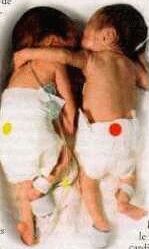 Heidi
and Paul Jackson's twin girls, Brielle and Kyrie, were born October 17, 1995,
12 weeks ahead of their due date. Standard hospital practice is to place preemie
twins in separate incubators to reduce the risk of infection. that was done
for the Jackson girls in the neonatal intensive care unit at the Medical Center
of Central Massachusetts in Worcester.
Heidi
and Paul Jackson's twin girls, Brielle and Kyrie, were born October 17, 1995,
12 weeks ahead of their due date. Standard hospital practice is to place preemie
twins in separate incubators to reduce the risk of infection. that was done
for the Jackson girls in the neonatal intensive care unit at the Medical Center
of Central Massachusetts in Worcester.
Kyrie, the larger sister at two pounds, three ounces, quickly began gaining
weight, and calmly sleeping her newborn days away. But Brielle, who weighed only
two pounds at birth, couldn't keep up with her. She had breathing and heart-rate
problems. The oxygen level in her blood was low, and her weight gain was slow.
Suddenly, on November 12, Brielle went into critical condition. She began
gasping for breath, and her face and stick-thin arms and legs turned bluish-gray.
Her heart rate was way up, and she got hiccups, a dangerous sign that her body
was under stress. Her parents watched, terrified that she might die.
Nurse Gayle Kasparian tried everything she could think of to stabilize Brielle.
She suctioned her breathing passages and turned up the oxygen flow to the incubator.
Still Brielle squirmed and fussed as her oxygen intake plummeted and her heart
rate soared.
Then Kasparian remembered something she had heard from a colleague. It was
a procedure, common in parts of Europe but almost unheard of in this country,
that called for double-bedding multiple-birth babies, especially preemies.
Kasparian's nurse manager, Susan Fitzback, was away at a conference, and
the arrangement was unorthodox. But Kasparian decided to take the risk.
"Let me just try putting Brielle in with her sister to see if that helps,"
she said to the alarmed parents. "I don't know what else to do."
The Jacksons quickly gave the go-ahead, and Kasparian slipped the squirming
baby into the incubator holding the sister she hadn't seen since birth. Then
Kasparian and the Jacksons watched.
 No sooner had the door of the incubator closed then Brielle snuggled up to
Kyrie - and calmed right down. Within minutes Brielle's blood-oxygen readings
were the best they had been since she was born. As she dozed, Kyrie wrapped
her tiny arm around her smaller sibling.
No sooner had the door of the incubator closed then Brielle snuggled up to
Kyrie - and calmed right down. Within minutes Brielle's blood-oxygen readings
were the best they had been since she was born. As she dozed, Kyrie wrapped
her tiny arm around her smaller sibling.
By coincidence, the conference Fitzback was attending included a presentation
on double-bedding. This is something I want to see happen at The Medical Center,
she thought.
But it might be hard making the change. On her return she was doing
rounds when the nurse caring for the twins that morning said, "Sue, take a look
in that isolette over there."
"
I can't believe this," Fitzback said. "This is so beautiful."
"You mean, we can do it?" asked the nurse.
"Of course we can," Fitzback replied.
Today a handful of institutions around the country are adopting double-bedding,
which seems to reduce the number of hospital days. The practice is growing quickly,
even though the first scientific studies on it didn't begin until this past January.
But Heidi and Paul Jackson don't need any studies to know that double-bedding
helped Brielle. She is thriving. In fact, now that the two girls are home, they
still steep together - and still snuggle.
Understanding The Continuum Concept
Jean Liedloff
Infants whose continuum needs are fulfilled during the early, in-arms
phase grow up to have greater self-esteem and become more independent than those
whose cries go unanswered for fear of "spoiling" them or making them too dependent.
According to Jean Liedloff, the continuum concept is the idea that in order
to achieve optimal physical, mental and emotional development, human beings
— especially babies — require the kind of experience to which our species adapted
during the long process of our evolution. For an infant, these include such
experiences as...
- Constant physical contact with his mother (or another familiar caregiver
as needed) from birth;
- Sleeping in his parents' bed, in constant physical contact, until he
leaves of his own volition (often about two years);
- Breastfeeding "on cue" — nursing in response to his own body's signals
- Being constantly carried in arms or otherwise in contact with someone,
usually his mother, and allowed to observe (or nurse, or sleep) while the
person carrying him goes about his or her business — until the infant begins
creeping, then crawling on his own impulse, usually at six to eight months
- Having caregivers immediately respond to his signals (squirming, crying,
etc.), without judgment, displeasure, or invalidation of his needs, yet
showing no undue concern nor making him the constant center of attention
- Sensing (and fulfilling) his elders' expectations that he is innately
social and cooperative and has strong self-preservation instincts, and that
he is welcome and worthy.
In stark contrast, a baby subjected to modern Western childbirth and child-care
practices often experiences:
- Traumatic separation from his mother at birth due to medical intervention
and placement in maternity wards, in physical isolation except for the sound
of other crying newborns, with the majority of male babies further traumatized
by medically unnecessary circumcision surgery.
- At home, sleeping alone and isolated, often after "crying himself to sleep
- Scheduled feeding, with his natural nursing impulses often ignored or "pacified"
- Being excluded and separated from normal adult activities, relegated
for hours on end to a nursery, crib or playpen where he is inadequately
stimulated by toys and other inanimate objects;
- Caregivers often ignoring, discouraging, belittling or even punishing
him when he cries or otherwise signals his needs; or else responding with
excessive concern and anxiety, making him the center of attention;
- Sensing (and conforming to) his caregivers' expectations that he is
incapable of self-preservation, is innately antisocial, and cannot learn
correct behavior without strict controls, threats and a variety of manipulative
"parenting techniques" that undermine his exquisitely evolved learning process.
Evolution has not prepared the human infant for this kind of experience. He
cannot comprehend why his desperate cries for the fulfillment of his innate
expectations go unanswered, and he develops a sense of wrongness and shame about
himself and his desires. If, however, his continuum expectations are fulfilled
— precisely at first, with more variation possible as he matures — he will exhibit
a natural state of self-assuredness, well-being and joy.

A Baby Cries: How Should Parents Respond?
 In Suzanne Arms' book
Immaculate Deception II, she explains how in the 1970s Dr. T. Berry Brazelton
studied newborns to see whether they could feel hopeless or depressed. In the
following quote from page 186, Arms tells of a study that Dr. Brazelton did
in which he videotaped babies crying in order to get the attention of their
moms, and, eventually, when this failed, their descent into hopelessness.
In Suzanne Arms' book
Immaculate Deception II, she explains how in the 1970s Dr. T. Berry Brazelton
studied newborns to see whether they could feel hopeless or depressed. In the
following quote from page 186, Arms tells of a study that Dr. Brazelton did
in which he videotaped babies crying in order to get the attention of their
moms, and, eventually, when this failed, their descent into hopelessness.
In a heartrending series of videotaped sessions, each baby can be seen crying
to elicit a response from its mother and, failing to do so, working even harder.
After a number a minutes of making all kinds of faces and trying to make eye
contact, each baby finally reaches its level of tolerance and begins to look
away from the mother, finding it too difficult to continue making an effort
with no response. The baby eventually turns it sic face away from its mother's
face. Then it turns toward the mother again and tries to rouse a response. Each
time it turns away for longer and longer periods. Finally, each baby slumps
down, drops its head, and shows all the signs hopelessness.
Immediate response to a baby's cry went unquestioned for thousands of years
until recent times. In our culture, we assume that crying is normal and unavoidable
for babies. Yet in natural societies where babies are carried close to the care-giver
much of the day and night for the first several months, such crying is rare.
In contrast to what many in our society would expect, babies cared for in this
way show self-sufficiency sooner than do babies not receiving such care.
In fact, research on early childhood experiences consistently shows that
children who have enjoyed the most loving care in infancy become the most secure
and loving adults, while those babies who have been forced into submissive behavior
build up feelings of resentment and anger that may well be expressed later in
harmful ways. In spite of this research, most arguments for ignoring crying
are based on fears of "spoiling" the baby.
The more babies are held, the less they cry
 Studies have shown that the more babies are held, the less they cry and
fuss. In indigenous cultures where baby-wearing is the norm, babies often cry
for only a few minutes a day – in contrast to Western babies, who often cry
for hours each day. Crying is exhausting for both the baby and his parents,
and may cause long-term damage as the baby’s developing brain is continually
flooded with stress hormones.
Studies have shown that the more babies are held, the less they cry and
fuss. In indigenous cultures where baby-wearing is the norm, babies often cry
for only a few minutes a day – in contrast to Western babies, who often cry
for hours each day. Crying is exhausting for both the baby and his parents,
and may cause long-term damage as the baby’s developing brain is continually
flooded with stress hormones.
Babies who do not need to spend their energy
on crying are calmly observing and actively learning about their environment.
Baby-wearing is especially useful for colicky or "high need" babies, who are
far happier being worn, but placid, content babies and children will also benefit
greatly from the warmth and security of being held close.
Growing Healthy Kids: Calming the Cry of Colic
Jen Allbritton, CN
The elusive infant condition called colic has perplexed parents and health
professionals alike for many years. The seemingly endless crying spells, sleep
loss and worry leads to stress and anxiety for all. Each baby is unique and
is affected by a myriad of factors, but all respond in their own ways. Nevertheless,
current research and the principles set forth by Weston A. Price give parents
the best chance of maximizing their wee one's happiness and preventing excessive
toe-curling scream sessions.
Colic - What We Know
Crying is baby-communication and has many possible drivers; crying babies
could be hungry, cold, wet, under-stimulated, over-stimulated, bored, in pain,
sick, moody or anything else under the sun. It often takes some trial and error
to figure out what will soothe a baby. When crying becomes loud and persistent,
when soothing efforts are fruitless, and when potential physical conditions
have been ruled out, the doctor will generally give a diagnosis of colic,1 which
means, "We have no idea why your baby will not stop crying!" How frustrating!
 The average infant cries between two and three hours a day. The commonly
accepted clinical definition of colic is the "rule of three": crying for more
than three hours per day, for more than three days per week, and for more than
three weeks in an infant that is well-fed and otherwise healthy. However, when
a baby is in the throws of a high-pitched crying-fit, five minutes can feel
like three hours. Some people are just better able to tolerate the noise and
feelings of helplessness than others. This is what makes the term colic, or
even excessive crying, so subjective. A Brazilian study found that as many as
80 percent of mothers believed their infants had colic; however, using the definition
above, only 16.3 percent actually had the condition. Thus, as with many things,
"excessive crying" really is in the eye--or ear--of the beholder.
The average infant cries between two and three hours a day. The commonly
accepted clinical definition of colic is the "rule of three": crying for more
than three hours per day, for more than three days per week, and for more than
three weeks in an infant that is well-fed and otherwise healthy. However, when
a baby is in the throws of a high-pitched crying-fit, five minutes can feel
like three hours. Some people are just better able to tolerate the noise and
feelings of helplessness than others. This is what makes the term colic, or
even excessive crying, so subjective. A Brazilian study found that as many as
80 percent of mothers believed their infants had colic; however, using the definition
above, only 16.3 percent actually had the condition. Thus, as with many things,
"excessive crying" really is in the eye--or ear--of the beholder.
Ultimately, science doesn't know much about colic, but there are many gimmicky
"colic cure" sale pitches to make your wallet burst into more tears than your
child. Nevertheless, there are a number of contributing factors that if remedied
may improve the situation. These issues may or may not be directly involved
in the cause of colic, but they are all things that should be evaluated by every
parent. It all fits into the realm of learning about your unique bundle of joy
and encouraging his or her best possible health.
Treating Colic in Infants
Sheilagh King
Colic can be very trying for both parents and baby. It can often result in
endless sleepless night and midnight drives around the neighborhood in an attempt
to comfort a distressed baby.
Homeopathy is a natural system of medicine in which the remedies that are
used stimulate the body’s own healing powers. It is concerned with treating
the whole person—not only the disease. For this reason, people with the same
problem may often be treated with different remedies. The homeopathic alternative
to treating infants' colic and children's digestive problems is an individually
chosen homeopathic medicine. When homeopathy is used by a skilled practitioner
and the case is individualized according to the patient’s history and physical exam, it is safe and can
help even those stubborn cases of infant colic.
The following are brief descriptions of some of the more commonly used homeopathic
remedies for colic:
- BRYONIA is for the infant who is irritable and does not want to be carried.
He is worse from movement and touch with a tendency toward constipation.
- CHAMOMILLA is for the "impossible cranky irritable" baby who moves about
in agony. He cries one minute for something and then pushes it away the
next. Both baby and parents are miserable. He is better from being carried.
One notable feature is that one cheek is red and the other is pale.
- COLOCYNTHIS should be considered for severe colic. The baby screams
with gas pains and is doubled over. The pain is better with firm pressure
on the tummy.
- MAGNESIA PHOSPHORICA is used when relief is brought on by gentle abdominal
pressure. The baby also feels better with warmth on the belly.
- PULSATILLA is for the affectionate baby who is irritable and desires
sympathy and attention; although they may be irritable from the pain they
experience, they are still basically friendly.
Some people theorize that the reason for colic is that the infant is allergic
to milk or to some other food. The homeopathic view of food allergies is basically
that the food is not "the problem." Rather, it is the individual's underlying
state of health. The disease process produces poor assimilation and utilization
of the food, which then ultimately creates symptoms. Homeopaths have found that
the homeopathic medicines are effective in re-establishing health and thereby
reducing food allergies.
Homeopathic medicines have wide
applications for pediatric complaints and
it is usually worthwhile seeking out safe, effective alternatives to pediatric
problems first. Homeopathic medicines may not only help to improve the health
of infants and children, but will probably also help them to become healthy adults.
Dispelling the Fear of Spoiling - Babies, like food, only spoil when left alone
Dr. Bill and Martha Sears
Once upon a time parents were taught that holding their baby a lot or responding
too quickly to an infant’s cries would result in a clingy, dependent child.
Fortunately, both experience and research have shown these beliefs are unfounded.
Babies cry to communicate with their caregivers. In fact, crying is one of the
only ways infants can express their needs. And the quality of response a baby
receives from the adults he depends on directly affects his social and emotional
development. Researchers studied two groups of mother-infant
pairs. Group 1 mothers were nurturing and tuned-in to their infants’ cues and needs. When their
babies cried, these mothers responded quickly and lovingly. Group 2 mothers,
fearful of spoiling their babies and being manipulated, gave more restrained
responses. Mothers in this group put their infants on a schedule and responded
less intuitively and nurturantly to their child’s cues.
William and Martha Sears, a pediatrician and a registered nurse respectively,
team up with two of their doctor sons to update their 1993 guide to "attachment
parenting." Advocating a "high-touch style of parenting to balance the high-tech
life of the new millennium," the authors teach new parents how to bond with
their babies through seven fundamental behaviors, including breastfeeding, "babywearing"
and setting proper boundaries. When parents keep close to their babies by bringing
them into bed at night and picking them up when they cry, the infants develop
better, the authors argue; rather than becoming spoiled, they become more healthy
and independent.
The Importance of the In-Arms Phase
Jean Liedlof
 In the two and a half years during which I lived among Stone Age Indians
in the South American jungle (not all at once, but on five separate expeditions
with a lot of time between them for reflection), I came to see that our human
nature is not what we have been brought up to
believe it is. Babies of the Yequana tribe, far from needing peace and quiet
to go to sleep, snoozed blissfully whenever they were tired, while the men,
women, or children carrying them danced, ran, walked, shouted, or paddled canoes.
Toddlers played together without fighting or arguing, and they obeyed their
elders instantly and willingly.
In the two and a half years during which I lived among Stone Age Indians
in the South American jungle (not all at once, but on five separate expeditions
with a lot of time between them for reflection), I came to see that our human
nature is not what we have been brought up to
believe it is. Babies of the Yequana tribe, far from needing peace and quiet
to go to sleep, snoozed blissfully whenever they were tired, while the men,
women, or children carrying them danced, ran, walked, shouted, or paddled canoes.
Toddlers played together without fighting or arguing, and they obeyed their
elders instantly and willingly.
The notion of punishing a child had apparently never occurred to these people,
nor did their behavior show anything that could truly be called permissiveness.
No child would have dreamed of inconveniencing, interrupting, or being waited
on by an adult. And by the age of four, children were
 contributing more to the
work force in their family than they were costing others.
contributing more to the
work force in their family than they were costing others.
Babes in arms almost never cried and, fascinatingly, did not wave their arms,
kick, arch their backs, or flex their hands and feet. They sat quietly in their
slings or slept on someone's hip — exploding the myth that babies need to flex
to "exercise." They also did not throw up unless extremely ill and did not suffer
from colic. When startled during the first months of crawling and walking, they
did not expect anyone to go to them but rather went on their own to their mother
or other caretakers for the measure of reassurance needed before resuming their
explorations. Without supervision, even the smallest tots rarely hurt themselves
Babies Need Their Mothers Beside Them
James J. McKenna, Ph.D.
Throughout human history, breast-feeding mothers sleeping alongside their
infants constituted a marvelously adaptive system in which both the mothers'
and infants' sleep physiology and health were connected in beneficial ways.
By sleeping next to its mother, the infant receives protection, warmth, emotional
reassurance, and breast milk - in just the forms and quantities that nature intended.
This sleeping arrangement permits mothers (and fathers) to respond quickly to
the infant if it cries, chokes, or needs its nasal passages cleared, its body
cooled, warmed, caressed, rocked or held. This arrangement thus helps to regulate
the infant's breathing, sleep state, arousal patterns, heart rates and body
temperature. The mother's proximity also stimulates the infant to feed more
frequently, thus receiving more antibodies to fight
 disease. The increased nipple contact also causes changes in the mother's
hormone levels that help to prevent a new pregnancy before the infant is ready
to be weaned. In this way, the infant regulates its mother's biology, too; increased
breast-feeding blocks ovulation, which helps to ensure that pregnancies will
not ordinarily occur until the mother's body is able to restore the fat and
iron reserves needed for optimal maternal health.
disease. The increased nipple contact also causes changes in the mother's
hormone levels that help to prevent a new pregnancy before the infant is ready
to be weaned. In this way, the infant regulates its mother's biology, too; increased
breast-feeding blocks ovulation, which helps to ensure that pregnancies will
not ordinarily occur until the mother's body is able to restore the fat and
iron reserves needed for optimal maternal health.
It is a curious fact that in Western societies the practice of mothers, fathers
and infants sleeping together came to be thought of as strange, unhealthy and
dangerous. Western parents are taught that "co-sleeping" will make the infant
too dependent on them, or risk accidental suffocation. Such views are not supported
by human experience worldwide, however, where for perhaps millions of years,
infants as a matter of course slept next to at least one caregiver, usually
the mother, in order to survive. At some point in recent history, infant separateness
with low parental contact during the night came to be advocated by child care
specialists, while infant-parent interdependence with high parental contact
came to be discouraged. In fact, the few psychological studies which are available
suggest that children who have "co-slept" in a loving and safe environment become
better adjusted adults than those who were encouraged to sleep without parental
contact or reassurance.
Sleep Deprived Baby? Try Sunlight
For many parents, getting their baby to sleep at night can become a daunting
task. Often times it seems that nothing will help; however, researchers may
have discovered a natural remedy: Sunlight. According to a study, babies exposed
to twice as much light during the day (between noon and 4 pm) became better
sleepers at night. Parents are advised to take their babies out in sunlight.
The sun is an amazing healing source that is absolutely underappreciated in
our current culture.
Sweet Dreams : A Pediatrician's Secrets for Baby's Good Night's Sleep
Paul M. Fleiss M.D.
Most new parents quickly and sadly discover the difficulty of getting a child
first to go to sleep, and then to sleep throughout the night. Dr. Fleiss, a
noted family pediatrician for more than 30 years, shares his secrets for discovering
a child's natural sleep patterns, developing positive bedtime rituals, nutritional
and lifestyle aids to sleep, and how co-sleeping affects normal growth and development.
Rebecca from University Place, WA United States: "I was looking
for a book that would help me cope with my 2-year-old's difficulty falling asleep
at night. Unlike most people, I just wasn't comfortable with the "cry-it-out"
methods that are so popular now and that method was completely ineffective with
my daughter. This book was a lifesaver for me because Dr. Fleiss is the first
author who writes about sleep issues with a gentle loving approach that was
right for us. After only one night, my daughter's bedtime is MUCH better for
us all. This was a great book!"
Note from Shirley:"I 'd like to express my deep gratitude
to Dr. Paul Fleiss, who was my handicapped son 's
pediatrician for over 15 years and took wonderful care of my little angel."
Can you Teach your Baby to Read?
Dr. Robert Titzer, Ph.D. "Babies as young as three or four
months old can be taught to read. We have babies who by nine months
of age, who can read many words." In more than 15 years of teaching, Dr. Titzer
has worked extensively in researching and developing a method that takes advantage
of your baby's natural learning skills. He believes that babies can learn to
read as soon as they have visual tracking with their eyes. That's somewhere
around 2-3 months old. Dr. Titzer says it's up to parents to work with their
baby at home. He doesn't believe in waiting to let teachers at school do the
work- because about 90-percent of brain development happens in the first five
years of life.
In the first year, your baby’s brain triples in weight. By the end of the
second, your toddler’s brain weighs three quarters that of an adult’s. The brain’s
activity increases with its weight. The metabolism of a baby’s brain, as measured
by
how much blood sugar it uses, builds steadily from birth until the age of
3. At that point, your child’s brain is more than twice as active as yours,
and it will remain so until he or she reaches puberty. All that internal energy
and growth is matched by the toddler’s external activities: exploring the world,
reaching out for objects, gurgling and practicing sounds (the building blocks
of language).
The essence of the matter is to keep the process simple so that the baby
can follow it, and to keep it enjoyable so that the baby follows it out of self-interest.
If you are trying to force lessons into your tiny baby, then you are simply
digging your way for a permanent fear and hatred of your kid towards reading.
You don't have an option to force, you must make the sessions fun. It must be
in an environment that the baby wants to live and relive in. The idea is that
after your baby goes through one or a few of reading sessions, the baby will
start looking out for the next reading session out of own. This can happen only
if the reading session is an enjoyable experience. The best is to identify a
session of around 30-40 minutes every day at a fixed time, so that it becomes
a routine for the baby. The time can be more or less depending on the age and
health of the baby.
How You Can Release The Genius In Your Child
Now with the help of an early childhood brain-training program, you can
accelerate the development potential of your child's brain, from age 3-month
and above, quickly and naturally. Your child's mental capabilities can progress
faster than you ever thought possible.
The Nurturing Father
James Kimmel, Ph.D.
 Studies of groups of people living outside civilization have indicated that
it is rare for children to have fathers who are absent or who are not
nurturing. In hunter-gatherer societies, both mother and father, as well
as other male and female members of the group, are usually described by anthropologists
as indulgent of, and nurturing toward, all children. Despite the commonly held
belief in Western civilization that the individual is primarily governed in
his behavior by selfish motives and instincts, that "man is a beast to man",
it is much more probable that our prehistoric ancestors were individuals
who cared for, and about, each other. The idea that the human individual is
basically selfish and uncaring of others, and that to become socialized, he
must repress and control his self-serving impulses, ignores the human nurturing
necessity and its powerful influence on individual development and group living.
Studies of groups of people living outside civilization have indicated that
it is rare for children to have fathers who are absent or who are not
nurturing. In hunter-gatherer societies, both mother and father, as well
as other male and female members of the group, are usually described by anthropologists
as indulgent of, and nurturing toward, all children. Despite the commonly held
belief in Western civilization that the individual is primarily governed in
his behavior by selfish motives and instincts, that "man is a beast to man",
it is much more probable that our prehistoric ancestors were individuals
who cared for, and about, each other. The idea that the human individual is
basically selfish and uncaring of others, and that to become socialized, he
must repress and control his self-serving impulses, ignores the human nurturing
necessity and its powerful influence on individual development and group living.
Both male and female evolved to continue their development after birth in
relation to a nurturing mother. The natural nurturing process does more than
keep infants alive. It initiates them into a way of living in which there is
someone who cares for and about them. Nurtured children learn that security
and satisfaction are found in attachment to another human. For these reasons,
sociability and socialization are natural outcomes of appropriate mothering.
Our requirement of mothering is the root of our connection to each other. The
mother in her attachment and commitment to her child establishes that human
life is about affirming the life of another as well as oneself.
The Family Bed
For most of human history, babies have slept with their mothers. Except in
Western, industrialized nations, this is still accepted as the natural thing
to do. But most parents in North America today have been raised on the cultural
ideal of an angelic baby sleeping through the night, alone, in an immaculately
decorated nursery.
It turns out that "ideal" isn't so easy to achieve. We are told that our
babies need to learn to be "independent" and to go to sleep on their own. And
so, on the advice of books, grandparents, friends, and "sleep-training" programs,
babies cry themselves to sleep, night after heart wrenching night.
As soon as they can climb out of the crib, they make it clear that they
want to be with mommy and daddy. Some exhibit such persistence that the exhausted
parents must allow their toddler into their bed -- or resort to such desperate
measures as netting over the crib, locking the baby's bedroom door, or responding
to night-time fears with threats and spankings. Bedtime becomes a battleground.
What is Attachment Parenting?

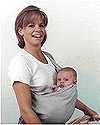 It starts with nursing your babies carrying them close to your body in a
sling or carrier. It continues with responding immediately to your child's cries
and allowing for child-led weaning. The family bed is a big part of attachment
parenting.
It starts with nursing your babies carrying them close to your body in a
sling or carrier. It continues with responding immediately to your child's cries
and allowing for child-led weaning. The family bed is a big part of attachment
parenting.
Patty Burke -"I can't remember how old our son was
when we discovered that there was a name for the method of parenting that my
husband and I had adopted. We just "knew" not to let him cry himself to sleep,
to share sleep with him, to let him breastfeed as he needed to, to hold him
and wear him and love him 24 hours a day. And then I discovered Katie's book
and she reinforced all of our instincts! Whenever I have doubts (sometimes put
upon me by society), all I have to do is re-read certain chapters or pages and
it all comes clear to me again: my husband and I are the experts when it comes
to our son. We should and will follow our instincts.Yes, before reading this
book, we had all the mainstream purchases: crib, swing, baby bucket, baby bouncer
seat, stroller. And we did use those items a few times, but not to the extreme
that we've seen other parents, leaving baby alone for long periods of time.
Our son has grown into a happy and healthy toddler and we owe a lot of it to
being so Attached!"
J. Prescott, Ph.D. - "The single most important child rearing
practice to be adopted for the development of emotional and social healthy infants
and children is to carry the newborn/infant on the body of the mother/caretaker
all day long..."
Researchers from the Centers for Disease Control and Prevention (CDC) have
found that 15 brands of powdered infant formula are
contaminated with perchlorate, a rocket fuel component detected in drinking
water in 28 states and territories. The two most contaminated brands, made from
cow’s milk, accounted for 87 percent of the U.S. powdered formula market in
2000, the scientists said. The CDC scientists did not identify the formula brands
they tested. The CDC findings, published in the March 2009 edition of the Journal
of Exposure Science and Environmental Epidemiology, raise new concerns about
perchlorate pollution, a legacy of Cold War rocket and missile tests. Studies
have established that the chemical is a potent thyroid toxin that may interfere
with fetal and infant brain development. The new CDCstudy provides some of the strongest evidence yet that a legally enforceable
safe drinking water level for perchlorate should be a priority for the Obama
administration. Rocket Fuel Found In Most Powdered Infant Formula.
Advantages of a Breast fed Infant
 There was a time when doctors thought that infant formula was superior to
breast milk. They were wrong about that. Mothers were told to "not spoil their
babies and to let them cry". Later, doctors realized that infants wither and
die without human touch. What about all those Soviet children that were left
on their own, crying in their cribs without proper attention? Now these children,
who were adopted into this country have all sorts of horrendous emotional problems
and learning disabilities. Babies need nurturing and it is not spoiling them
to provide it. Spoiling means "ruining" and you cannot ruin a child with love
and affection, you ruin him by abandoning him and ignoring his needs.
There was a time when doctors thought that infant formula was superior to
breast milk. They were wrong about that. Mothers were told to "not spoil their
babies and to let them cry". Later, doctors realized that infants wither and
die without human touch. What about all those Soviet children that were left
on their own, crying in their cribs without proper attention? Now these children,
who were adopted into this country have all sorts of horrendous emotional problems
and learning disabilities. Babies need nurturing and it is not spoiling them
to provide it. Spoiling means "ruining" and you cannot ruin a child with love
and affection, you ruin him by abandoning him and ignoring his needs.
Dr Robert Mendelsohn, M.D.- "The bottle fed human baby is
substantially more likely to suffer a whole nightmare of illnesses: diarrhea,
colic, gastrointestinal and respiratory infections, meningitis, asthma, hives,
other allergies, pneumonia, eczema, obesity, hypertension, atherosclerosis,
dermatitis, growth retardation, hypocalcemic tetany, neonatal hypothyroidism,
necrotizing enterocolitis, and sudden infant death syndrome. From a scientific,
biological standpoint, formula feeding cannot be considered an acceptable alternative
to breastfeeding, especially since more than ninety-nine percent of new mothers
are perfectly capable of doing it.
Even premature infants should get breast milk. When I had my pediatric training
more than twenty-five years ago, I was strongly (and thankfully) influenced
by one of the great nurses in the field of premature babies, Evelyn Lundeen.
Miss Lundeen not only encouraged but insisted that mothers supply breast milk
to their premies even to those who weighed only two pounds. I can remember watching
husbands deliver the bottles of milk their wives had pumped. There's no doubt
in my mind that the premature infant fed breast milk does much better than the
premature infant fed formula In my own practice I have discharged from the hospital
many babies who weighed less than five pounds, all breastfed, of course, since
now I won't accept a child as a patient unless the mother is determined to breastfeed."
The Deadly Influence of Infant Formula in America
While the dangers of formula feeding aren’t something you’re likely
to hear in your doctor’s office, the conclusions can be derived
through an examination of the available scientific research on
infant mortality in the United States and across the world. There
are studies showing artificial feeding’s impact on overall infant
death rates in both developing and undeveloped countries. While
studies offering comparative death rates are not available for
industrialized regions, there are numerous studies providing
comparative occurrence rates for many illnesses and disorders in
the United States and other industrialized nations. Many more
reports are available extolling superior survival rates and
decreased illness rates among breastfed infants, but only those
with solid numbers are useful here. We can assemble the statistics
from these studies to build a firm picture of the ratio of infant
deaths for U.S. formula-fed babies against those who are breastfed.
The FDA found melamine and cyanuric acid, a related chemical, in samples of
baby formula made by major U.S. manufacturers . November 28, 2008
- Melamine can cause kidney and bladder stones and, in worst cases, kidney failure
and death. If melamine and cyanuric acid combine, they can form round yellow
crystals that can also damage kidneys and destroy renal function. Melamine was
found in Good Start Supreme Infant Formula With Iron made by Nestle, and cyanuric
acid was detected in Enfamil Lipil With Iron infant formula powder made by Mead Johnson.
If Breastfeeding is not possible: Healthy Alternative to Conventional Infant Formula
Mary G. Enig, PhD
Make no mistake: the best food for baby is breastmilk from a healthy mother.
However, many situations call out for a good substitute: adopted and orphaned
babies, babies born to mothers with serious health problems, and babies whose
mothers do not have enough milk (a situation that does happen occasionally)
deserve to receive something better than commercial formula. The following questions
have been compiled by the authors over a period of several years and should
cover most situations encountered by parents giving homemade formula to their babies.
Healthier Baby Formulas - For the infant to remain as healthy as possible,
he must obtain a proper balance of all the essential fats, which is difficult
to impossible, especially when you are changing mother nature and trying to
create a formula.
Non-Breast Milk In Infancy Increases Asthma Risk
Introducing milk other than breast milk to infants younger than 4 months
old increases the risk of asthma and atopy (a predisposition to certain allergies).
In the first study of its kind, the investigators followed over two thousand
children from before birth through their
 6th birthday, questioning their parents
regarding various manifestations of asthma and allergy. Children who were fed
milk other than breast milk before 4 months of age experienced higher rates
of all indicators of asthma and allergy, the report indicates. Such children
were 25% more likely to be diagnosed with allergy and 30% more likely to have
a positive skin test for allergies than were children who received only breast
milk during their early months. The total duration of exclusive breastfeeding
was less important, though longer breastfeeding was associated with less asthma
and allergy. Because the introduction of non-breast milk was more closely associated
with asthma and atopy than the duration of breastfeeding, the investigators
postulate that the exclusion of potentially allergy-causing components in milk
other than breast milk may account for the protective effect. British Medical
Journal September 25, 1999;319:815-819.
6th birthday, questioning their parents
regarding various manifestations of asthma and allergy. Children who were fed
milk other than breast milk before 4 months of age experienced higher rates
of all indicators of asthma and allergy, the report indicates. Such children
were 25% more likely to be diagnosed with allergy and 30% more likely to have
a positive skin test for allergies than were children who received only breast
milk during their early months. The total duration of exclusive breastfeeding
was less important, though longer breastfeeding was associated with less asthma
and allergy. Because the introduction of non-breast milk was more closely associated
with asthma and atopy than the duration of breastfeeding, the investigators
postulate that the exclusion of potentially allergy-causing components in milk
other than breast milk may account for the protective effect. British Medical
Journal September 25, 1999;319:815-819.
Cow Milk and Soy Milk Allergy
Milk allergy occurs when the child's immune system mistakenly sees the milk
protein as dangerous and tries to fight it off. This starts an allergic reaction,
which can cause an infant to be fussy and irritable, and cause an upset stomach
and other symptoms. Most children who are allergic to cow's milk may tolerate
goat or sheep's milk (not always) or sour milk (buttermilk). A great number
of babies are also allergic to the protein in
soy milk. Infants who are breastfed have
a lower risk of developing a milk allergy than infants who are formula fed.
Although goat milk is rich in fat, it must be used with caution in infant
feeding as it lacks folic acid and is low in vitamin B12, both of which are
essential to the growth and development of the infant.
Beware of Chemically Treated Mattresses
Jeanee Andrewartha
Babies are susceptible to the chemicals in new mattresses and SIDS (Sudden Infant Death Syndrome)
has been linked to the formation of toxic
gases from chemically treated mattresses. These chemicals have been found
in high concentrations in the livers of babies who have died. A whole new
meaning to ‘cot death’; where the cot actually kills the baby.
If you think the story ends there well unfortunately much of the bedding
sold is treated with synthetic antibacterial/antifungal chemicals. The manufacturers
claim that they are safe because they meet the EPA standards, but for those
of you who know what goes into our food, those standards do not prove that
the product is safe. The active ingredients of these chemicals are not revealed
but protected by patents. The consumer is not protected only the product
is. Certified organic cotton, can be bought that has not been treated, though
it would be best to check first with the manufacturer about whether the
fabric has been treated with synthetic chemicals in the dying process.
Cotton is one of the most sprayed crops in the world. It take up approximately
0.5% of agricultural land, but over 25% of pesticides go into its production.
Residues are left in the fabric, which is then treated with toxic dyes.
That is why when you buy a new garment, the manufacturer recommends you
wash it before you wear it. However, washing will only remove some of the
chemicals. So if you don’t want chemicals to leach into your body through
your skin or leach into the waterways or soils and back into the food, choose
certified organic cotton clothes and bedding. Limit your exposure to electrical
devices, especially in the bedroom and get a good night sleep and you will
feel better for it. Jeanee Andrewartha lives in Australia with her husband
and 7 home shooled children.
Kathy Gibbons Ph.D - "Picture your future child standing
in her new white crib, contentedly gnawing on the bars. You'd never want
her to ingest pesticides or formaldehyde; however, most conventional paints
and finishes, even those used on baby furniture, contain such toxic chemicals.
Even if your baby never chews the furniture, it can off-gas dangerous fumes
that she'll inhale for months and sometimes years."
How fish oil may have saved babies' lives
Like most babies with his medical condition, Austin DuPonte of
Hudson was not expected to live long - He was born prematurely
and developed intestinal problems so severe that surgeries left him unable
to absorb enough nourishment. Babies with bowel troubles can be fed intravenously,
but most quickly develop liver problems. Without a costly liver transplant,
and sometimes even with one, these children usually don't make it to their
first birthday. But over the last two years, a simple finding made by doctors
at Children's Hospital Boston has apparently saved the life of Austin and
15 other babies. It's long been known that the intravenous fluid that kept
the babies alive -- called total parenteral nutrition -- was also destroying
their livers. The Children's doctors, led by Dr. Mark Puder, figured out
why total parenteral nutrition seemed to be causing these problems and how
to fix it. They swapped the IV feedings, giving the babies
fluids with fish oils, known as omega-3's, instead of the standard plant oils, or omega-6.
Within weeks, the patients' livers began to rebound, and they no longer
needed transplants.
What makes a Baby Susceptible to Allergies?
Soy-based formula or goat's milk formula are not recommended for allergic
or potentially allergic infants.
Your baby may inherit the tendency to develop allergies, if you, your
partner, or any of your family suffers from eczema, hayfever or
hives, allergic rhinitis, persistent cough, constant runny nose, asthma and food allergies
(especially allergy to dairy foods, eggs, wheat, soy, peanuts, nuts, fish
and shellfish), or recurrent ear infections.
Several studies have shown that breastfeeding helps to reduce the chance
of developing allergies when compared to feeding with standard milk or soy-based
formulas. However, this advantage is dependent on your diet. The same issues
as apply as in pregnancy, but again, it is important that in avoiding allergens
you don't compromise your own diet. If breastfeeding is not possible or
if a supplement to breast milk is desired, use a hypoallergenic formula (ask
your allergy specialist for advice on this).
Nutrition for Children and Babies
There are many serious consequences of generation after generation having diets that are
deficient in an element essential for normal development of the nervous
system. In 1996, Laura J. Stevens, of the Department of Foods and Nutrition,
Purdue University, and co-investigators published an extremely important
paper in Physiology and Behavior. The researchers found that boys with lower
levels of omega-3 fatty acids
in their blood showed more problems with behavior, learning, and health
than those with higher levels of total omega-3 fatty acids. Here, you'll
also learn the importance of enzymes and of bee pollen which is often referred to as nature's most
complete food.
Importance of Probiotics
Probiotics administered during pregnancy and lactation appears to promote the immune
system protective potential of breast-feeding. The probiotics also protect
infants against eczema during the first two years. There is a growing incidence
of allergic diseases in the Western world and researchers acknowledge the
need to offer primary protection to reverse the trend. The ideal source
of infant nutrition to provide protection from these diseases is breast-milk.
Its role, however, is elusive. Pediatricians in Finland undertook a double-blind,
placebo controlled study to determine the potential for protection against
allergic diseases by administering probiotics. Mothers who received probiotics
during pregnancy and lactation improved their anti-inflammatory transforming
growth TGF in their milk. In addition, it was shown that the
risk of developing
eczema during the infants first two years was significantly reduced compared
with the placebo group. Researchers concluded that maternal allergies were
a positive risk for eczema in the infant.
Homeopathy for Children and Babies
It is time that parents and physicians seek safe, natural and effective
alternatives to conventional, potentially harmful drugs. Homeopathic medicine
for children is one such alternative. Learn about homeopathic medicine for childhood
ailments such as bed wetting, chicken pox, measles, colds, flus, teething,
constipation, sore throats, earaches, diarrhea, and much more.