The Healing Power of Tea
 "Tea infuses the precious commodity of water with plants that have transmuted the
elements of sunshine and earth into nourishing constituents. It is quickly absorbed
into the body, inexpensive, and easy to prepare, and its physiological interaction
with the body has been proven time and again in scientific studies.Plant food and herbal medicine
help in another way as well by providing nutrients that
are essential to life. Teas are rich in antioxidants called polyphenols which
are plant chemicals that may help prevent cancer, heart disease, and other diseases."
"Tea infuses the precious commodity of water with plants that have transmuted the
elements of sunshine and earth into nourishing constituents. It is quickly absorbed
into the body, inexpensive, and easy to prepare, and its physiological interaction
with the body has been proven time and again in scientific studies.Plant food and herbal medicine
help in another way as well by providing nutrients that
are essential to life. Teas are rich in antioxidants called polyphenols which
are plant chemicals that may help prevent cancer, heart disease, and other diseases."
Monica Myklebust, MD A simple cup of tea not only has the power to soothe and relax but to deliver
healing herbal agents to the bloodstream more quickly than capsules, tinctures,
or infusions. Hot or iced, these pure and simple drinks offer delicious ways
to stay healthy and revitalize you from the inside out. The aromatic oils in
tea can serve to calm your nerves, relaxing you, as well as stimulating the
mind and breathing process. For these reasons, Zen Buddhist monks and Taoists
often use tea during meditation. Tannic acid stimulates digestion, and can help
destroy harmful bacteria. Flavanoids kill plaque bacteria promoting fresh breath
and healthy gums, despite the staining it might leave on your pearly whites.
Tea has been shown to reduce bad cholesterol, a cause of arteriosclerosis, aging
of the blood vessels, and increases good cholesterol. Containing vitamins A,
B2, C, D & P, as well as anti-oxidants, tea has been shown to reduce blood
pressure and the risk of heart disease.
VelociTeaVelociTea, The Gentle Detox Tea
VelociTea, also known as Holy Tea, is a unique herbal tea formulated in a proprietary blend of
organic herbs designed to promote the body self healing
by gently cleansing the digestive tract and detoxifying the body. This special blend consists of Blessed Thistle,
Persimmon leaves, Malva leaves, Marsh Mallow leaves,
Papaya, Ginger, Chamomile, and Myrrh that allows the gentle cleansing of
the whole body with continued use. All the enzymes that used to be in our food
to give us colon health have been destroyed with modern processing of foods
and pasteurization of dairy products. Now we can get back to enjoying perfect
colon health! The VelociTea contains no stimulants, no Senna and is not a laxative.>Blessed Thistle has been cultivated for centuries
as a medicinal herb. In the Middle Ages, thistle was one of the most common
European medicinal herbs. Early herbalists believed that this herb was a cure-all.
The plant gained the title "blessed" for its use in treating the plague and
smallpox. Blessed thistle is also used as a strong but gentle liver tonic herb,
promoting metabolic activities in the liver cells and toxin elimination. Especially noted as a tonic herb for women.
VelociTea is often used with great success by persons who suffered with:
- Loss of Mental Clarity and Concentration
- Excess Weight
- Constipation
- Stomach Ache Irregularity
- Ileitis Excess Gas
- Hemorrhoids Irritable Bowel Syndrome (IBS)
- So much more...

Detoxification Tea and a Healthy Colon
Dr. H. H. Boeker believed that over 90 percent of diseases are caused or complicated
by toxins created in the intestinal tract by unhealthy foods
that are not properly eliminated." Auto intoxication occurs when, due
to poor elimination, certain toxins escape from the bowel into the blood stream
and poison the body, causing a silent form of self-poisoning.
Every day your body is bombarded with millions of toxins
from genetically modified foods, toxic beverages,
polluted air and water, prescription drugs, excessive stress, attack by parasites, and exposure to heavy metals and radiation.
You absorb toxins from pesticides in crops, hormone-injected meat and dairy products, soy,
white flour, table salt, MSG (monosodium glutamate), microwaved foods,
refined sugar, artificial sweeteners, caffeine, alcohol,
electromagnetic radiation, poisoned drinking water containing arsenic, chlorine and fluoride,
industrial chemicals, and so much more! These toxins suppress your body's self healing
mechanism causing sickness, low energy levels, anxieties, weight gain,
and many other negative health conditions.
 Over 90% of these toxins enter your body through the INTESTINAL TRACT! From
there they enter your bloodstream and begin to damage every living cell, organ,
and biological system. Just as crops wither when vital water is withheld, your
body's self-healing mechanisms can become overwhelmed by toxins … and disease
or poor health is the result! Through my research, my former clinical practice,
and also my work as a natural health care educator and "living green" consultant,
I have discovered body toxins to be the underlying cause in nearly every case
of general illness and poor physical or mental health! I am thus able to affirm
the old saying that "Disease Starts and Health Begins in the Colon." Did you
know you can strengthen and retrain your intestinal system to work as the first
line of defense against toxins? Just as the potential for disease exists inside
the body, so does the solution!
Over 90% of these toxins enter your body through the INTESTINAL TRACT! From
there they enter your bloodstream and begin to damage every living cell, organ,
and biological system. Just as crops wither when vital water is withheld, your
body's self-healing mechanisms can become overwhelmed by toxins … and disease
or poor health is the result! Through my research, my former clinical practice,
and also my work as a natural health care educator and "living green" consultant,
I have discovered body toxins to be the underlying cause in nearly every case
of general illness and poor physical or mental health! I am thus able to affirm
the old saying that "Disease Starts and Health Begins in the Colon." Did you
know you can strengthen and retrain your intestinal system to work as the first
line of defense against toxins? Just as the potential for disease exists inside
the body, so does the solution!
Medicinal qualities of Blessed Thistle
by David Card (excerpts)
An important ingredient in the VelocTea, Blessed Thistle has an amazing variety of folk history,
medicinal uses, and modern applications. Richard Willfort describes internal and external uses of Blessed thistle: “Used
for colon problems, kills and expels worms, gallbladder diseases, liver diseases,
jaundice, and gastritis, dyspepsia, gas, and bloating…Also used for
constipation, feverish diseases and sluggishness of the gastrointestinal
tracts, and weakness of the stomach operations. It also improves and cleanses
the blood, anemia. it improves the lung and heart. It is especially good for
coughs, catarrh; beginning lung inflammation, lung or heart asthma, heart weakness
that are connected with stomach or colon problems. Used externally as a damp
warm pack for breast cancer, healing wounds, frostbite, and skin lupus of the face."
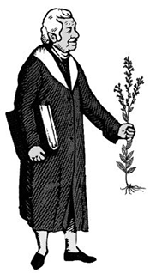 “For internal parasites; works well for worms. In contemporary herbalism,
Blessed Thistle is used to treat liver and mucous congestion, loss of appetite,
dyspepsia, jaundice, hepatitis and remove parasites such as worms
and flukes from the colon."
“For internal parasites; works well for worms. In contemporary herbalism,
Blessed Thistle is used to treat liver and mucous congestion, loss of appetite,
dyspepsia, jaundice, hepatitis and remove parasites such as worms
and flukes from the colon."
The Flora website lists the traditional uses of Blessed Thistle
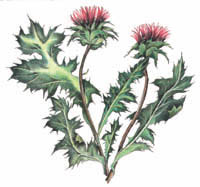 “Aqueous extract of whole, dried herb and flowers. Traditional usage: Acne, antioxidant,
anti-inflammatory, fcellular regeneration, cleansing, detoxifying, digestive
disorders, gastrointestinal disorders, headaches, hormone imbalances, skin disorders.
Through its bitter properties, blessed thistle increases the flow of gastric
juices relieving dyspepsia, indigestion, and headaches associated with liver congestion."
“Aqueous extract of whole, dried herb and flowers. Traditional usage: Acne, antioxidant,
anti-inflammatory, fcellular regeneration, cleansing, detoxifying, digestive
disorders, gastrointestinal disorders, headaches, hormone imbalances, skin disorders.
Through its bitter properties, blessed thistle increases the flow of gastric
juices relieving dyspepsia, indigestion, and headaches associated with liver congestion."
Nineteenth century herbalists prescribed Blessed Thistle as an infusion,
or tea, made from the plant tops for the treatment of
fevers along with liver and respiratory ailments. It is claimed that the warm
tea given to mothers will produce a good supply of milk and is also said to
be good for girls entering womanhood as a good tonic. Blessed thistle are commonly
referred as holy thistle, St. Benedict thistle, cardin, and spotted thistle
and also known as Cnicus benedictus Carduus benedictus and Carbenia benedicta.
Monica Myklebust, MD - "Teas are rich in antioxidants called
polyphenols which are plant chemicals that may help prevent cancer, heart disease,
and other diseases by:
- Inhibiting growth of cancer cells
- Reducing high blood pressure
- Protecting against stroke
- Improving blood flow to the heart
- Reducing total and LDL (bad) cholesterol
- Inhibiting the formation of blood clots in artery walls
- Steadying blood sugar levels
- Lowering the risk for osteoporosis
- Acting as an anti-inflammatory agent
- Enhancing immune function and helping fight infections
- Protecting against viral infections and liver disease
- Inhibiting the growth of bacteria that can cause gum disease, cavities,
and bad breath"
Holy ThisHoly Thistle (Blessed Thistle)
Blessed thistle is also known as holy thistle, St. Benedict thistle, cardin, and spotted thistle. This herbaceous annual has been cultivated for centuries
as a medicinal herb. It was a component of many herbal remedies used to combat the plague.
The herb was cultivated in monastery gardens as a cure for smallpox. Its specific
name is in honor of St. Benedict, the founder of a holy order of monks. The
ancient Romans ate the leaf fresh and boiled the root as a vegetable. Thistle
was once used as a nutritious fodder for cattle in Scotland, and the leaf, folded
between two slices of buttered bread, was eaten with the breakfast meal. British
and German Pharmacopoeias recognize that 'bitters', including blessed thistle,
stimulate bile flow and cleanse the liver. In Europe, blessed thistle, as a
"bitter vegetable drug" is considered to be a medicinal agent used to aid digestion
and promote health. The herb contains B-complex vitamins, calcium, iron, and
manganese.
Blessed thistle is considered by many contemporary herbalists and in traditional
folk use as a tonic, astringent, diaphoretic (increases perspiration), emetic
(induces vomiting), and stimulant. Both the blessed thistle and milk thistles
are recommended as a liver tonic, particularly when the liver disease is brought
on by alcoholism. It has been used in treatment of jaundice and hepatitis.A tea from the leaves, taken warm, will increase
perspiration, reduce congestion, and help to bring down fever. A mild infusion
is astringent and may relieve diarrhea. Blessed thistle is considered to be
one of the best herbs to stimulate the flow of milk in lactating women (lactating
women should always consult their physicians before taking this herb), and its
emmenagogue action (promotes menstrual discharge) helps to regulate female hormone
balance and relieve menstrual pain. Blessed thistle has also been used to treat
the vaginal discharge known as leucorrhea.
The herb is used in the commercial manufacture of herbal bitters, and is
considered a general tonic and digestive. Its bitter properties increase the
flow of bile and other gastric secretions. The herb may stimulate appetite and
relieve flatulence. Blessed thistle is said to relieve melancholy and lethargy,
and was traditionally fed to mentally ill persons. It acts to increase blood
circulation and aids memory. Applied externally in poultice form, blessed thistle is a good
treatment for shingles, wounds, and ulcers. The plant has antimicrobial
properties. The essential oil has been shown to have antibiotic action against
infections, specifically Staphylococcus aureus and S. faecalis. Blessed thistle
has a history in folk use for the treatment of heart ailments, cancers, and
as a contraceptive, but these, and other traditional uses, have not been confirmed
by research.
Historically, blessed thistle has been recommended as a treatment for stomach
upset, indigestion, constipation and gas. Some individuals employ this herbs,
as they would its cousin milk thistle, as a remedy for gallbladder and liver
disorders. However, there is only limited clinical evidence to support it use
medicinally. Notwithstanding, many individuals report that blessed thistle is
an effective medicinal healing herb. A few studies show that blessed thistle
may be useful as an anti-inflammatory.
Holy Thistle supports the liver in the release of toxins. Used medicinally
for over 2000 years, most commonly for the treatment of liver and gallbladder
disorders. Holy thistle products are popular in Europe and the United States
for various types of liver disease. Holy thistle is believed to have great power
in the purification and circulation of the blood. It is such a good blood purifier
that drinking a cup of thistle tea twice a day will help ease chronic headaches.
Holy Thistle is used for stomach and digestive problems, gas in the intestines,
constipation, and liver troubles. It is very effective for dropsy, strengthens
the heart, and is good for the liver, lungs, and kidneys. It is claimed that
the warm tea given to mothers will produce a good supply of milk. It is also
said to be good for girls entering womanhood as a good tonic.
The related milk thistle (Silybum marianum) is commonly used as a blood and
liver purifier. Blessed thistle, likewise, is considered to have a beneficial
effect on the blood which, in turn, enriches the milk.It has sometimes been
stated that the herb was first cultivated by Gerard in 1597, but as this book
was published twenty years previously it would appear to have been in cultivation
much earlier, and in fact it is described and its virtues enumerated in the Herbal of Turner in 1568.
Medicinal Action and Uses of Blessed Thistle
 In large doses, Blessed Thistle acts as a strong emetic, producing vomiting
with little pain and inconvenience. Cold infusions in smaller draughts are valuable
in weak and debilitated conditions of the stomach, and as a tonic, creating
appetite and preventing sickness. The warm infusion - 1 OZ. of the dried herb
to a pint of boiling water - in doses of a wine glassful, forms in intermittent
fevers one of the most useful diaphoretics to which employment can be given.
The plant was at one time supposed to possess very great virtues against fevers
of all kinds.
In large doses, Blessed Thistle acts as a strong emetic, producing vomiting
with little pain and inconvenience. Cold infusions in smaller draughts are valuable
in weak and debilitated conditions of the stomach, and as a tonic, creating
appetite and preventing sickness. The warm infusion - 1 OZ. of the dried herb
to a pint of boiling water - in doses of a wine glassful, forms in intermittent
fevers one of the most useful diaphoretics to which employment can be given.
The plant was at one time supposed to possess very great virtues against fevers
of all kinds.
It is said to have great power in the purification and circulation of the
blood, and on this account strengthens the brain and the memory. The leaves,
dried and powdered, are good for worms. It is chiefly used now for nursing mothers
the warm infusion scarcely ever failing to procure a proper supply of milk.
It is considered one of the best medicines which can be used for the purpose.
 It
is said to have obtained its name from its high reputation as a heal-all, being
supposed even to cure the plague. It is mentioned in all the treatises on the
Plague, and especially by Thomas Brasbridge, who in 1578 published his Poore
Man's Jewell, that is to say, a Treatise of the Pestilence, unto which is annexed
a declaration of the vertues of the Hearbes Carduus Benedictus and Angelica.
Shakespeare in Much Ado about Nothing, says: 'Get you some of this distilled
Carduus Benedictus and lay it to your heart; it is the only thing for a qualm....
I mean plain Holy Thistle.' The 'distilled' leaves, it says 'helpeth the hart,'
'expelleth all poyson taken in at the mouth and other corruption that doth hurt
and annoye the hart,' and 'the juice of it is outwardly applied to the bodie'
('lay it to your heart,' Sh.), 'therefore I counsell all that have Gardens to
nourish it, that they may have it always to their own use, and the use of their
neighbors that lacke it.'
It
is said to have obtained its name from its high reputation as a heal-all, being
supposed even to cure the plague. It is mentioned in all the treatises on the
Plague, and especially by Thomas Brasbridge, who in 1578 published his Poore
Man's Jewell, that is to say, a Treatise of the Pestilence, unto which is annexed
a declaration of the vertues of the Hearbes Carduus Benedictus and Angelica.
Shakespeare in Much Ado about Nothing, says: 'Get you some of this distilled
Carduus Benedictus and lay it to your heart; it is the only thing for a qualm....
I mean plain Holy Thistle.' The 'distilled' leaves, it says 'helpeth the hart,'
'expelleth all poyson taken in at the mouth and other corruption that doth hurt
and annoye the hart,' and 'the juice of it is outwardly applied to the bodie'
('lay it to your heart,' Sh.), 'therefore I counsell all that have Gardens to
nourish it, that they may have it always to their own use, and the use of their
neighbors that lacke it.'
Turner (1568) says: 'It is very good for the headache and the megram, for
the use of the juice or powder of the leaves, preserveth and keepeth a man from
the headache, and healeth it being present. It is good for any ache in the body
and strengtheneth the members of the whole body, and fasteneth loose sinews
and weak. It is also good for the dropsy. It helpeth the memory and amendeth
thick hearing. The leaves provoke sweat. There is nothing better for the canker
and old rotten and festering sores than the leaves, juice, broth, powder and
water of Carduus benedictus.'Topically, a poultice of blessed thistle is used
to soothe skin irritated by burns, scrapes, shaving, sunburn, and other relatively
minor injuries. A poultice is usually a soft cloth that has been soaked in a
medication, possibly heated, and applied to an aching or injured area of skin surface.
Precautions: There are no reported incidents of thistle toxicity. However,
as with most medicinal herbs, they should not be taken during pregnancy. Children
under two years should not be given the herb. Lactating women should consult
with a qualified herbalist before using the herb. Holy Thistle (Blessed Thistle)
Leaves are part of the VelociTea's Ingredients.
Do not confuse blessed thistle with its cousin, milk thistle Cardus Marianus,
they are two entirely different plants, despite the fact that they share a common
name (holy thistle), and both are known for supporting the liver. Blessed thistle
and its close cousin, milk thistle, are both excellent tonics for the
liver and digestion. Both are know to repair damaged liver cells. A distinctive
bitter, blessed thistle can be used as a digestive aid before meals. It is diuretic
and induces sweating. Used as a poultice or compress, the plant has a reputation
for curing chilblains. Mabey, Richard ,40 The herb is often used in combination
with other estrogenic herbs to treat menstrual difficulties. One of the main
uses in traditional herbal medicine is of a galactaloge, an herb that stimulates mother's milk.
PersimmonPersimmon leaves in VelociTea inhibits weight gain and lowers lipid levels
Supplementing a high-fat diet with powdered leaves taken from Native American persimmon trees
can inhibit weight gain and lower both food intake and plasma lipid
levels, research shows.Scientists believe that the rich fiber and phenolic
content of persimmon leaves, which are commonly used to make tea in India, increases
the amount of lipids removed from the body as feces. "Since the persimmon leaves
have beneficial effects on hemostatsis, constipation, hypertension, apoplexy,
and atherosclerosis, they have been broadly applied in food and medicine," says
J Lee, from the Ottogi Research Center in Kyonngi-do, The Republic of Korea
and colleagues.
To investigate if the leaves also improved metabolism and lipid levels, the
team fed three groups of rats either a normal control, high-fat, or high-fat
with powdered whole persimmon leaf diet, for 6 weeks. Eating the high-fat diet
without persimmon leaves increased the rats' body weight by an average 114%
in comparison with those fed the normal control diet.However, rats eating the
persimmon leaf supplemented high-fat diet had a final body weight similar to
that of the normal control group after 6 weeks.
"Thus indicating that persimmon leaf supplementation suppressed the excess body
weight gain that could be induced by high-fat feeding," say the authors
in the journal Food and Chemical Toxicology. They added that these rats gained
less weight because persimmon leaf consumption suppressed their food intake,
perhaps via the hormone leptin, levels of which were higher in the leaf-supplemented
group than the high-fat only group.
The VelociTea herbal tea blend contains
persimmon leaves and other healing herbs which assists the
body in eliminating waste, foreign matter, toxins and excess weight in a simple,
yet effective, easy-to-use but low cost method.

 Anita - Teacher Lost 80 lbs. in 10 months "Not only did
VelociTea herbal tea product burn fat, it curbed my appetite and added muscle
tone to my body. It also made my skin smooth on all parts of my body."
Anita - Teacher Lost 80 lbs. in 10 months "Not only did
VelociTea herbal tea product burn fat, it curbed my appetite and added muscle
tone to my body. It also made my skin smooth on all parts of my body."

 Ricky - Retired Lost 265 - VelociTea
herbal tea suppressed my appetite, helped me to be more focused and alert.
My concentration was increased, my glucose level stayed regulated, and it even
corrected my thyroid."
Ricky - Retired Lost 265 - VelociTea
herbal tea suppressed my appetite, helped me to be more focused and alert.
My concentration was increased, my glucose level stayed regulated, and it even
corrected my thyroid."


Sally - Real Estate Lost 60 lbs. "Not only did VelociTea herbal tea product make me look years younger, I feel years younger,
and I have more energy than ever. I would recommend this product to anyone!"
Eating persimmon leaves with a high-fat diet also created a less atherogenic lipid
profile by lowering plasma total cholesterol and triglyceride
concentrations, while increasing the ratio of high-density lipoprotein cholesterol
to total cholesterol. Finally, the researchers say the fact that rats eating
persimmon leaves had a higher daily fecal weight than the high-fat only group,
shows that the "combined effect of high-fiber and high-phenolic content in persimmon
leaf itself could enhance the fecal excretion of neutral and acidic sterol."
They conclude: "Efficacy tests of lipid-lowering action of persimmon leaf suggest
that this whole persimmon leaf food would be beneficial for regulation of lipid
metabolism or prevention of hyperlipidemia in an experimental animal model."
The tannins and flavonoids in Persimmon leaves have anti-hypertensive,
anti-carcinogenic, and anti-mutagenic properties. The lea. The leaf also acts
as a mild laxative. It is used for hemorrhoids and varicose veins. Persimmon
leaf extract containing astragalin, when taken orally, acts as a natural antihistamine
which helps to reduce allergic reactions. It relieves the symptoms of dermatitis,
reducing inflammation and thickening of the skin. Persimmon leaves also alleviate
itching. The astringent raw Persimmon fruit is used to treat constipation, gastro-intestinal
irritation, dysentery, chronic diarrhea, ulceration of the bowel and stomach,
catarrh of the rectum and colon, hemorrhoids, and to stop bleeding.
Persimmon leaves are a good source of important dietary antioxidants, such
as vitamin A & C and flavonoids. It has been widely used as a tea in oriental
countries. In particular, several tannins and flavonoids isolated from persimmon
leaf were recently found to have antihypertensive, anticarcinogenic
and antimutagenic actions. It is highly possible, therefore, that persimmon
leaves may be developed into potential sources of natural antioxidants and therapeutic
drugs.
Persimmon leaf is anti-allergic
and anti-pruritic in composition; in other words, an allergy or itching
preventive food. Furthermore, research has proven the therapeutic effect
of persimmon leaf extract on those suffering from
dermatitis or a skin condition such as Eczema. The preventive effect
of persimmon leaf extract on the dermatitis was dose-dependent and a continuous
intake of persimmon leaf extract significantly decreased its onset and development.
There were no significant adverse reactions observed. As well, studies have
shown that supplementation of persimmon leaf improves lipid profiles and suppresses
body weight gain in animals that were fed high-fat diets. It is also used topically
in some beauty products to help to clarify the skin and eliminate dull and dark areas.
Ancient cultivation of Persimmon in Japan
Persimmon has been cultivated in Japan for at least 1,000 years, where it is considered the national fruit. So
it only seems natural that Japanese researchers discovered that the main flavonoid
in persimmon—astragalin—inhibits the release of histamine in mice suffering
from atopic dermatitis. When the mice were given persimmon extract, they exhibited
fewer behavioral symptoms, such as scratching and biting their skin. There was
also a reduction of serum IgE, the antibodies produced in response to an allergen.
Additionally, tissue samples showed there was less inflammation and thickening
of the skin.
Malva LeaMalva Leaf (aka "Chinese Mallow" )
Often made into a tea to soothe the membranes of the digestive system. Malva
Leaf is mildly astringent and diuretic and used to treat gastroenteritis, stomach ache
and conditions of the spleen. The Chinese use Malva Leaf as an expectorant and
as a gargle for sore throat. Malva Leaf is also thought to be a mild laxative.
The seeds are used in Tibetan medicine, where they are considered to have a
sweet and astringent taste plus a healing potency. They are used in the treatment
of renal disorders, the retention of fluids, frequent thirst and diarrhea.
The word "malva" is derived from malakos, which in Greek means "soothing";
not surprisingly, malva tea is often given as a gargle to reduce throat inflammations.
Drinking the tea also helps calm stomach and intestinal irritation. Warm compresses
can draw toxins from pimples, abscesses and other skin inflammation while cool
tea compresses can help to relive superficial burns. The leaves of Malva sylvestris,
otherwise known as blue mallow, are rich in mucilage. The mucilage of M. sylvestris
is made up of high molecular weight acidic polysaccharides (Classen B, et al.,
Planta Med 64(7): 640-44 (1988)). The leaf tea is traditionally believed to
be useful as an anti-inflammatory, decongestant, humectant, expectorant, and
laxative. It has also been used internally for soothing sore throats, laryngitis,
tonsillitis, coughs, dryness of the lungs, and digestive upsets. Mallow is also
used as a poultice for healing wounds and skin inflammations. In traditional
medicine, mallow leaf tea is also used against abnormal growths of the stomach
and to alleviate urinary infections (Bisset NG (ed). Malvae folium--Mallow leaf.
In Herbal Drugs and Phyto-pharmaceuticals (1994, CRC Press, Stuttgart, pp 313-316).>The Malva or Chinese Mallow plant (Malva verticillata) is a member of the Malvaceae
family which also includes the Marsh Mallow and the Hibiscus. The leaves have
a mild pleasant flavor. Malva has been cultivated in China for over 2,500 years,
and is now cultivated in some countries of Europe as a tasty salad green. Malva
seed contains mucilage, polysaccharides and flavonoids. In traditional medicine,
the Malva leaf was often made into a tea to sooth the membranes of the digestive
system. It is a demulcent (the mucilage soothes and softens irritated tissues,
especially the mucus membranes), mild diuretic, emollient (softens the skin),
and a mild laxative (a gentle stimulant of the bowels). Malva Leaf teas are
used in the treatment of renal disorders, the retention of fluids, frequent
thirst, and diarrhea. Malva Leaf has been used to treat stomach ache, gastroenteritis,
irritable bowel, and conditions of the spleen. The Chinese use Malva Leaf as
an expectorant and as a demulcent gargle to soothe a sore throat. It can also
soothe a bronchial irritation in persons with bronchitis or emphysema. (Beware
of Chinese Mallow teas which also contain Senna or Cassia angustifolia. which
are strong laxatives and can create dependency. VelociTea Detox Tea does NOT
contain Senna.
The seed contains mucilage, polysaccharides and flavonoids. It is demulcent,
(soothes and softens irritated tissues, especially the mucus membranes) diuretic,
emollient, (softens the skin) galactogogue (increases milk flow in nursing mothers),
and gentle stimulation of the bowels. The seeds are used in Tibetan medicine,
where they are considered to have a sweet and astringent taste plus a healing
potency. They are used in the treatment of renal disorders, the retention of
fluids, frequent thirst and diarrhea. The weedy Malva Leaf has been used interchangeably
for food, tea and medicine for thousands of years. The Aztec's used Malva Leaves
for Bronchitis, Tonsillitis, Gastroenteritis, Pleuresia (Inflammation of the
membrane that covers the lungs), Leucorrea or White Discharge, Inflammation
of the Cervix, Inflamed Hemorrhoids, Colitis, Rectiti, Intestinal Infections,
Cutaneous Diseases and to Soften Tumors and Abscess. Malva Leaves are part of
the VelociTea Holy Tea's Ingredients.
MarshmallMarshmallow Root and Leaf
The Marsh Mallow or Marshmallow (Althaea officinalis) was used by the ancient
Greeks to remedy bruises and bleeding, and as a mild laxative. It was used in
medieval Europe for indigestion and diarrhea. The Marsh Mallow root or leaf
was traditionally used to soothe and support the intestines. It is rich in calcium,
zinc, iron, sodium, iodine, vitamin B complex, and pantothenic acid. Herbs high
in mucilage, such as Marsh Mallow and Malva Leaf (of the same family), are often
helpful for symptomatic relief of coughs and irritated throats.
Marshmallow has expectorant and demulcent properties, which accounts for
this herb's historical use as a remedy for the respiratory tract, particularly
in cases of irritating coughs with bronchial congestion. Marsh Mallow root and,
to a lesser extent, Marsh Mallow leaf both contain significant percentages of
mucilage, a natural gummy substance that does not dissolve in water. Like other
mucilage-containing substances, Marsh Mallow swells up and becomes slick when
it is exposed to fluids.>The resulting slippery material coats the linings of the mouth, throat, and stomach
to relieve irritation and control coughing associated with respiratory conditions
such as smoker's cough. Herbs high in mucilage, such as Marshmallow, are often
helpful for symptomatic relief of coughs and irritated throats. Mallow has expectorant
and demulcent properties, which accounts for this herb's historical use as a
remedy for the respiratory tract, particularly in cases of irritating coughs
with bronchial congestion. Marsh Mallow may also have mild anti-infective, immune-boosting,
and diuretic properties. In the British Herbal Compendium the use of Marsh Mallow
is listed for gastroenteritis, peptic and duodenal ulcers, colitis, and enteritis.
Topically, Marsh Mallow is used to soothe and soften irritated skin, and as
a remedy for cuts, wounds, abscesses, boils, burns, and varicose veins. The
edible leaves are used as salad greens in France.
It is an old-time remedy for bladder infection, digestive upsets, fluid retention,
intestinal disorders, kidney problems, sinusitis and sore throat. Marshmallow
is a natural source of beta-carotene, amino acids [amino acids are the "building
blocks" of protein], minerals and vitamins and is often used as a filler in
the compounding of pills. Primary chemical constituents in Marshmallow include
substantial mucilage, polysaccharides, flavonoids (quercetin), kaempferol, asparagine,
tannins, lecithin and pectin. The great demulcent and emollient properties of
Marshmallow make it useful in cases of inflammation and irritation of the alimentary
canal and of the urinary and respiratory organs. Recently, Marshmallow has been
used as an expectorant to treat a variety of upper respiratory problems. Marshmallow
also contains large amounts of vitamin A, calcium, zinc and significant amounts
of iron, sodium, iodine and B-complex vitamins. Like slippery elm, Marshmallow
reduces inflammation and has a calming effect on the body. Topically, marshmallow
is used to soothe and soften irritated skin. It also sooths irritation and inflammation
caused by bronchitis, urinary tract infections, colitis and other problems such
as constipation.
HOW TO PREPARE VELOCITEA
Each Plastic Bag has two tea bags. From that you will end up with a gallon of tea.
Step 1
Bring 32 oz or 4cups of water to a boil... let sit until you can put your finger
in the water without getting burned. Pour the hot water into a glass pitcher
or kettle. Place the 2 tea bags in the water and let sit 8 hours or overnight.
Step 2 After the tea has steeped for 8 hours take out the
tea bags. Get a one gallon container “Glass if you can find one” and pour in
the steeped tea in, and add the remainder of water to make 1 gallon of tea.
That's it! Your Tea is ready to DRINK! If you do not have room in your fridge
for a gallon jug leave the tea in the concentrate form and mix 1 part tea to
3 parts water prior to drinking when heating the tea use a small pot. Keep the tea in the refrigerator. You can dry your tea bags and
use the leaves in your Salads, shakes or any dish that you prepare. Some people
drink 20 oz a day or more. (8oz with Lunch and Dinner then a 4 oz with a snack)
DO NOT MICROWAVE the Tea bags or the water used to make your VelociTea Tea.
Do not subject the herbs to excessive heat that could destroy the essential
enzymes. Make your VelociTea with pure, clean, water that has come to a full
boil, then remove the heat and let the boiling stop before
adding the tea bags. You may re-heat the VelociTea mixture later, but do not
microwave it. Heat it on the stove just to a gentle boil, not to a rapid boil.
Two bags of VelociTea produce one gallon.
LEAVE THE TEA BAGS IN THE LIQUID TEA when you store it, to keep your VelociTea
infused with the ingredients. If you are not noticing any effects within a few
days to a week, you may have forgotten this and have been drinking VelociTea
which is too weak to work effectively.
4
- Do not microwave tea!!!
Microwaves will destroy
the natural enzymes and render some important nutrients ineffective.
- If you prefer to drink your VelociTea warm or hot, you can heat it in
a saucepan or tea kettle - but do NOT heat the mixture to the boiling point.
- Always drink the VelociTea with food - not on its own. Drink about 8
ounces with meals such as breakfast and dinner, and drink about 4 ounces
with a snack or a light lunch. A standard teacup holds about 6 ounces.
- Drink plenty of water. Not drinking enough water reduces your body's
ability to get rid of wastes and toxins. Drinking enough water is especially
important while detoxing your body. It helps your kidneys, sweat glands,
lymphatic system, lungs, and digestive tract flush out toxins and waste
material. Water acts as the carrier to transport nutrients into your cells
and flush waste material out of your cells.
 Note
from Shirley: As with all true natural cure, the road to better health
may begin with a healing crisis.
As you move toward better health with natural healing programs and better nutrition,
healing begins to occur. As part of the healing process the body will begin
to discard toxic residues which have built up in your body over the years. The
healing process usually does not occur without repercussions. During the initial
phase of healing, as your body begins to clean house, (detoxify) and your vital
energy begins to repair and rebuild internal organs, you may experience headache,
uneasiness, flu like symptoms and fatigue. This is called a healing crisis.
You may feel worse before you feel better. As you continue to improve, you may
begin a process called retracing. For example, if you used to get skin rashes,
the rashes may reappear or get worse for a period of time as your body eliminates
toxins through the skin. You may also experience an initial increase in urination,
or you may feel more nervous. In actuality, you are not getting worse, you are
actually getting better. Eventually you will reach a plateau of better health.
During the healing crisis, it is important to not suppress these temporary symptoms
with drugs or the healing process may become interrupted.
Note
from Shirley: As with all true natural cure, the road to better health
may begin with a healing crisis.
As you move toward better health with natural healing programs and better nutrition,
healing begins to occur. As part of the healing process the body will begin
to discard toxic residues which have built up in your body over the years. The
healing process usually does not occur without repercussions. During the initial
phase of healing, as your body begins to clean house, (detoxify) and your vital
energy begins to repair and rebuild internal organs, you may experience headache,
uneasiness, flu like symptoms and fatigue. This is called a healing crisis.
You may feel worse before you feel better. As you continue to improve, you may
begin a process called retracing. For example, if you used to get skin rashes,
the rashes may reappear or get worse for a period of time as your body eliminates
toxins through the skin. You may also experience an initial increase in urination,
or you may feel more nervous. In actuality, you are not getting worse, you are
actually getting better. Eventually you will reach a plateau of better health.
During the healing crisis, it is important to not suppress these temporary symptoms
with drugs or the healing process may become interrupted.
An ancient Chinese Legend
Once there was a man who knew 100,000 healing properties of herbs. He taught
his son 80,000 secrets. On his deathbed, he told his son to visit his grave
in five years, and there he would find the other 20,000 secrets. When the son
went to his father's grave, he found, growing on the site, the tea shrub....
A charming legend tells how this ordinary plant became the first natural
wonder in the world of herbal teas.
The story takes us back to ancient China in 2737 b.c. when one day, Emperor
Shen Nung was kneeling before a fire, heating water. Suddenly a wind stirred.
Leaves fluttered down from a branch over his head and fell into the boiling
water. The aroma captivated Shen Nung and he decided to taste the brew.
Where did these aromatic leaves come from? An ancient wild species of the
black tea shrub. When the leaves are fermented, they produce oolong or black
tea, but when they are brewed fresh, as in Shen Nung's tea, they yield the refreshing
green tea, which contains the potent antioxidant catechin, a bioflavenoid with
antibacterial and anticancer properties.
For centuries in China, monks and herbalists studied plants for their healing
properties, and handed down their knowledge to the next generation by verbal
instruction. To illustrate the importance of tea, a tale tells of an ancient
Chinese herbalist who knew 100,000 healing properties of herbs, and began to
pass on his wisdom to his son. The herbalist taught his son 80,000 secrets,
but fell ill before he could complete the lessons. On his deathbed, the herbalist
told his son to come to his grave five years from the date of his death, and
there he would find the other 20,000 secrets.
On the fifth year, the obedient son went to his father's grave, and found,
growing on the site, the black tea shrub.
The black tea shrub is a plant that has been endowed with the Taoist belief
that beauty and harmony are achieved by order and ritual. Every detail in the
planting, picking, preparation of the leaves, and ceremonial customs for drinking
tea became a cultural phenomenon in the Orient. It was passed on to other cultures
as humble gifts from Buddhist monks. When Japanese monks journeyed to China
to study with Chinese monks, they returned home with seedlings from the black
tea shrub as parting gifts. Today, Japan specializes in the production of green
teas, now known as its national beverage. The plants that grow in Japan today
are thought to be offshoots of those first seedlings.
The black tea shrub is a plant that has sailed the world on clipper ships
and trade routes. In 1559, a tea merchant from Persia told a Venetian scholar
about his experience in China, drinking tea. The scholar wrote an account of
the merchant's tea tale that set the port of Venice buzzing. What was this mysterious
brew? Everyone wanted to taste it. By the early 1600s, the Dutch East India
Trading Company was bringing shipments of dried herbs from the black tea shrub
in specially-lined boxes to Europe.
Tea was such precious cargo in its early years of import to Europe, it was
reserved for royal tables, or tea-tasting parties of the rich and influential.
It was introduced as an exotic medicinal beverage that could promote longevity
and cure many disorders. The herb's price exceeded one hundred dollars per pound.
But the herb wasn't the only expense involved.
To follow the Chinese custom, tea-drinking ceremonies in Europe required
imported china. Tiny Ming teacups from China were made of porcelain and held
only a few sips of tea. The cups rested on porcelain saucers, and to brew the
tea, a proper Chinese teapot was needed, along with a Chinese tea jar to store
the dried leaves. This was a costly endeavor that kept tea out of reach for
average people. At the time, the process for making porcelain was not known
in Europe, and to curb the import costs for drinking tea, the Dutch developed
an imitation of the Chinese tea service in elegant blue and white delftware.
One of the earliest tea parties on record in America was held in 1674 in
the Dutch Colony of New York (then called New Amsterdam). To taste the newly
imported teas, society ladies arrived in their best dresses, carrying their
own teacups, fashioned from delicate china, with bowls the size of wineglasses.
To this day, many herbalists still specify herbal tea doses as "the size of
a small wineglass."
A hundred years later, the Sons of Liberty brewed up the most memorable tea
party of them all. In 1773, Americans had independence on their minds, and Britain's
prohibitive taxes on tea sparked a revolution. Thirty-two cases of expensive
dried herbs were tossed into the harbor on the night of the Boston Tea Party.
It was the signal for the birth of a new nation.
For an ordinary plant, the black tea shrub has quite a few tales to tell
of romance and intrigue, old worlds and new worlds, culture and customs. But
it wasn't the only plant in the tea garden.
Locally grown herbs had been used for teas all over the world, and traded
in their own way, though not as aggressively as black, oolong, and green teas.
Many Mediterranean herbs were brought to Europe by the early crusaders and the
Roman army. Other herbs followed the trade routes of saffron to the far east,
and were exchanged for black tea leaves.
Early American colonists learned the secrets of locally grown herbs from
the Indians, and these discoveries played an important role in the fight for
independence. To protest the British taxes on tea in 1773, American women in
Boston, Hartford, and other New England cities vowed to drink teas from indigenous
weeds instead of imported teas. The brews they came up with were called Liberty
Tea. Among them were the antiviral flowers of chamomile, calcium-rich raspberry
leaves, and wild American sage, which is so admired by the Chinese as an herb
for longevity that it remains a major American export to China today.